

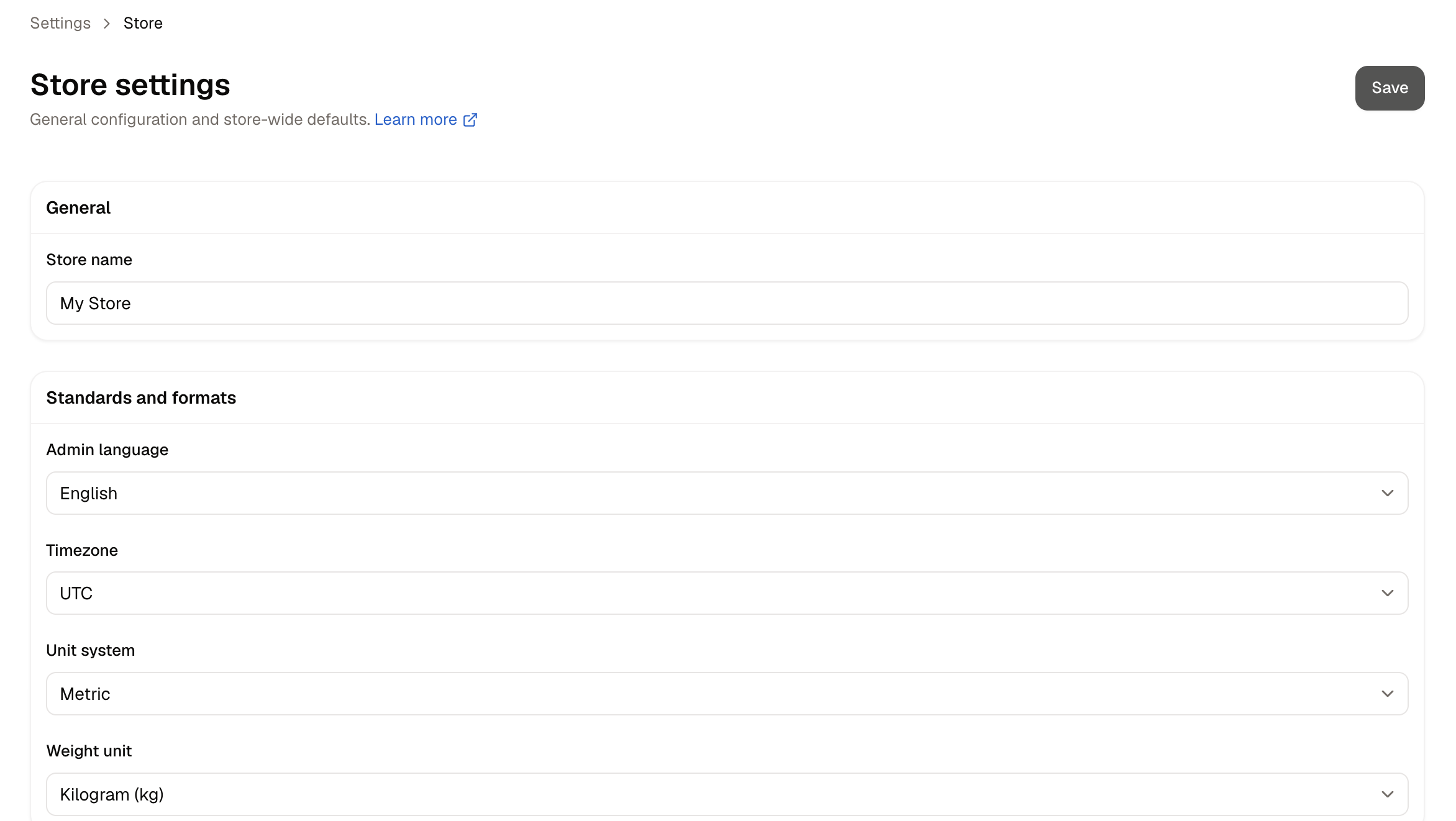
The page is one long scroll divided into titled sections, with a single Save button at the top. It stays greyed out until you change something, and it saves the whole page rather than one section.
General
The name your business trades under. It is the one setting on this page that customers see everywhere, so it is worth getting right before you open.- Store name - What your store is called. This appears in the dashboard, in emails and on the storefront.
Standards and Formats
How the store reads and measures. These affect what your team sees in the dashboard and the units products are described in, so set them to match how your business already works rather than where your customers are.- Admin language - The language your team sees in the dashboard. This does not change the storefront.
- Timezone - The timezone dates and times are shown in across the dashboard.
- Unit system - Metric or Imperial, used for product dimensions.
- Weight unit - Kilogram (kg) or Gram (g) for Metric, or Pound (lb) or Ounce (oz) for Imperial.
Storefront Access
Who can see your store before signing in, and whether they can buy without an account. This is the difference between an open retail shop and a trade store where prices are only shown to approved customers.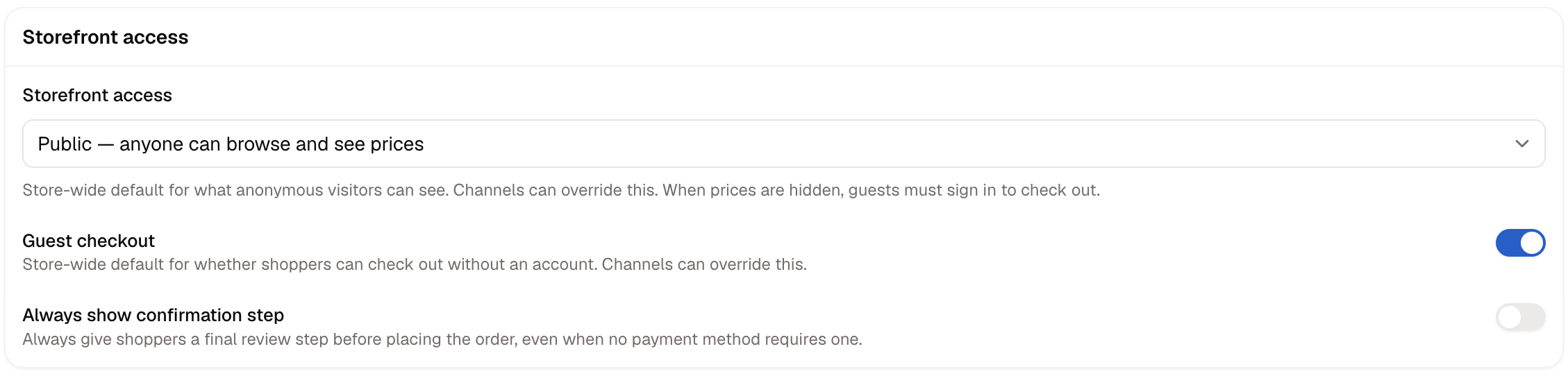
- Storefront access - The store-wide default for anonymous visitors:
- Public - Anyone can browse and see prices.
- Prices hidden - Visitors must sign in to see prices. Guests must sign in to check out.
- Login required - Visitors must sign in to browse at all.
- Guest checkout - Whether shoppers can check out without creating an account.
Both settings are defaults that a sales channel can override. If you change one here and a storefront does not behave as expected, check that channel’s own settings rather than changing this again.
- Prices hidden is how most wholesale and trade stores work. A visitor can browse the range and see what you sell, but not what it costs, until you have approved their account.
- Login required goes further and closes the catalogue as well. A visitor sees nothing at all until they sign in, so choose it only when the range itself is confidential.
Addresses
What customers are asked for when entering an address. Every extra field is one more thing between a shopper and a completed order, so only ask for what you will actually use.- Company field - Show a company field on address forms during checkout. Worth turning on if you sell to businesses.
- Require phone number - Make a phone number mandatory on customer addresses. Some carriers need one for delivery.
Order Numbers
How orders and other numbered documents are referenced. These are the numbers your team quotes on the phone and customers quote back in emails, so readability matters more than you might think.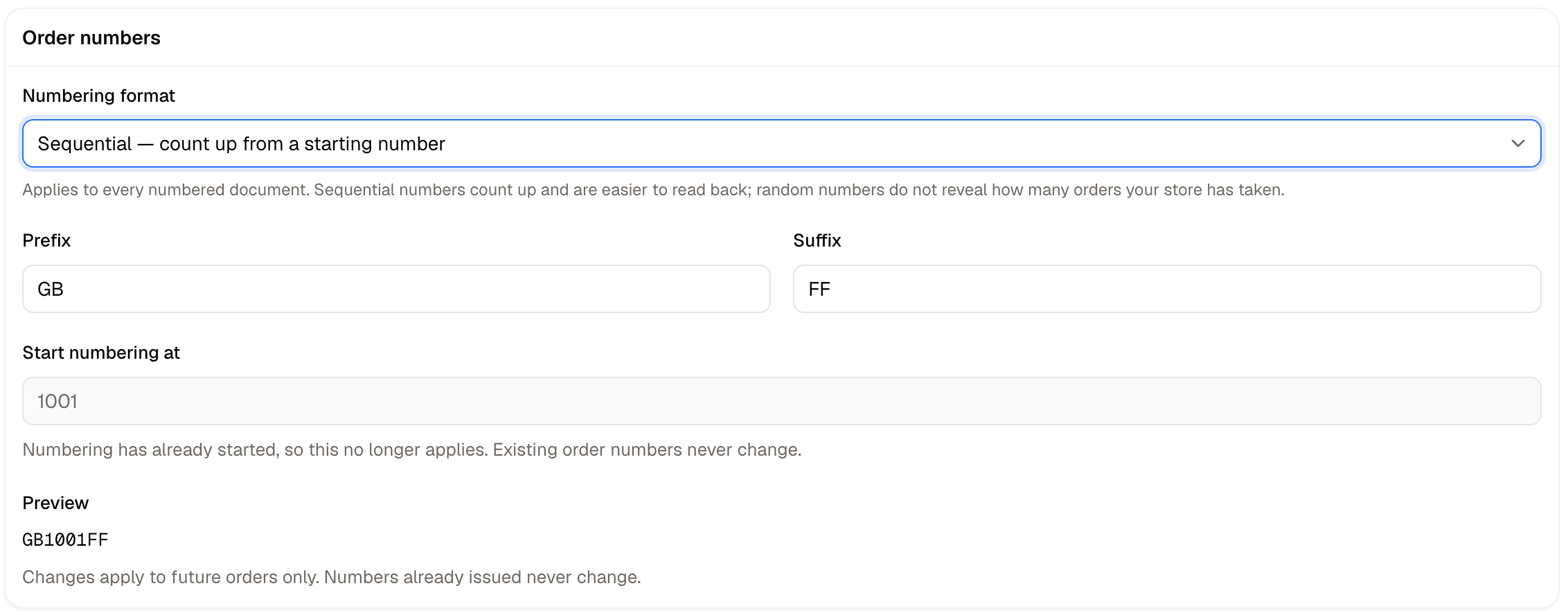
- Numbering format:
- Sequential - Counts up from a starting number. Easier to read back over the phone, and easier to sort.
- Random - Unpredictable digits, so your numbers do not reveal how many orders your store has taken.
- Prefix and Suffix - Text wrapped around the number, such as an
Rprefix. - Start numbering at - The number to begin counting from.
- Preview - Shows what the next number will look like as you change the settings above.
Payments
When money moves, and which address decides the tax. The charging setting has the widest reach of anything on this page, because it applies to every payment method unless one overrides it.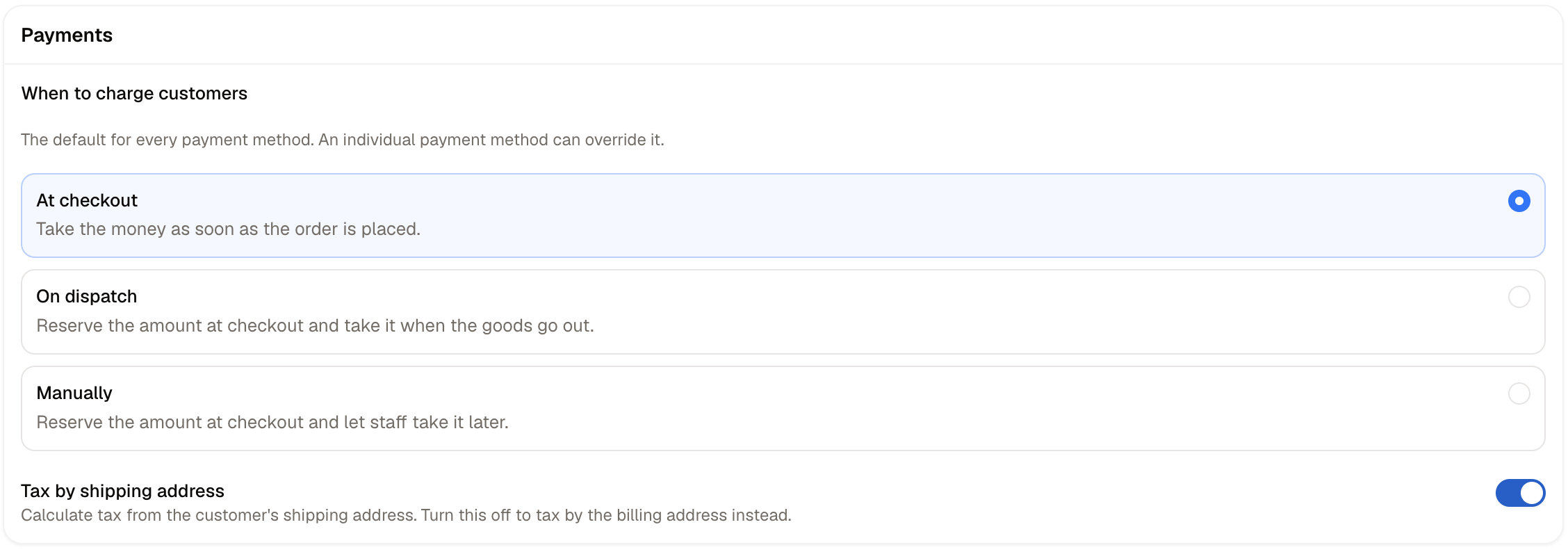
- When to charge customers - The default for every payment method:
- At checkout - Take the money as soon as the order is placed.
- On dispatch - Reserve the amount at checkout and take it when the goods go out.
- Manually - Reserve the amount at checkout and let staff take it later.
- Tax by shipping address - Calculate tax from the customer’s shipping address. Turn this off to tax by the billing address instead.
An individual payment method can override When to charge customers. See Payment Methods for when that is worth doing.
Inventory
How stock is counted and reserved. These settings decide whether Spree keeps track of quantities at all, whether a unit is held while someone checks out, and when your team is warned that something is running low.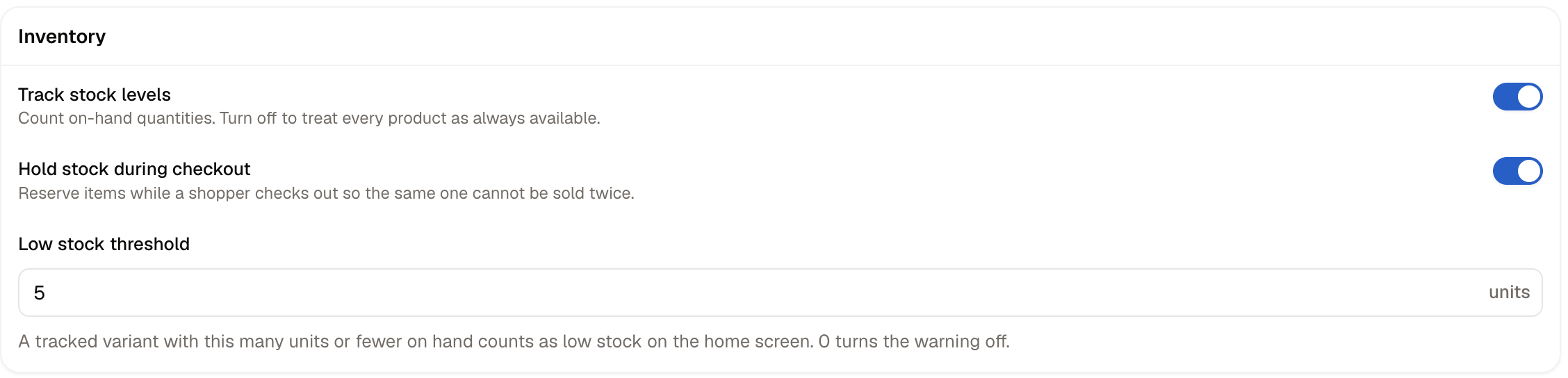
- Track stock levels - Count on-hand quantities. Turn this off to treat every product as always available, which suits made-to-order goods or services.
- Hold stock during checkout - Reserve items while a shopper checks out, so the same unit cannot be sold twice.
- Low stock threshold - A tracked variant with this many units or fewer counts as low stock on the home screen. Set it to 0 to turn the warning off.
Pricing Source
Where prices are answered from. Most stores price from their own catalog and never change this, but a business running an ERP or a contract-pricing system can have that system answer instead.- Prices come from - Spree (built in) prices from your catalog and price lists. An external system can answer instead.
Inventory Source
Where stock levels are answered from. As with pricing, this exists for stores whose warehouse or ERP system is the authority on stock rather than Spree.- Stock levels come from - Spree (built in) uses your own stock records. An external system can answer instead.
Catalog
Three switches covering how products behave across the store. Each one is small on its own, but the price history switch has a legal dimension worth reading before you skip past it.
- Show products without a price - List products that have no price in the shopper’s currency. Leave it off to hide anything unpriced rather than showing a product nobody can buy.
- Record price history - Keep past prices so the storefront can show the lowest price of the last 30 days.
- Allow duplicate SKUs - Let more than one variant share the same SKU.
Record price history exists for EU price indication rules, which require a discount to be shown against the lowest price of the previous 30 days. Turn it on before you start discounting, because it only keeps prices from the moment it is enabled.
Digital Downloads
Defaults for how long a download link works and how often it can be used. These apply to every digital product you sell, and an individual file can override them where something needs tighter or looser limits.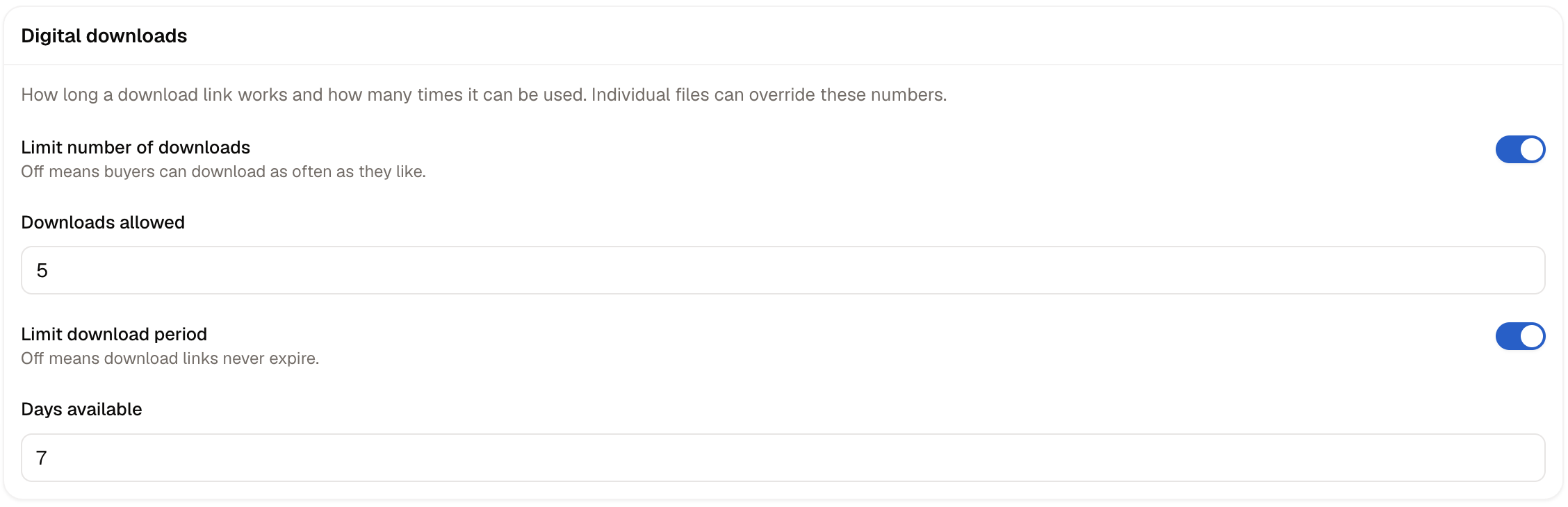
- Limit number of downloads - Off means buyers can download as often as they like.
- Downloads allowed - How many downloads each buyer gets.
- Limit download period - Off means download links never expire.
- Days available - How many days a link stays valid.
Saving Changes
Click Save at the top of the page. The button is greyed out until something has changed, and it saves every section at once, so you can work down the page and save once at the end.Further Reading
- Payment Methods - Overriding when customers are charged, per method
- Sales Channels - Overriding storefront access and guest checkout per channel
- Inventory - The stock figures the tracking settings produce