

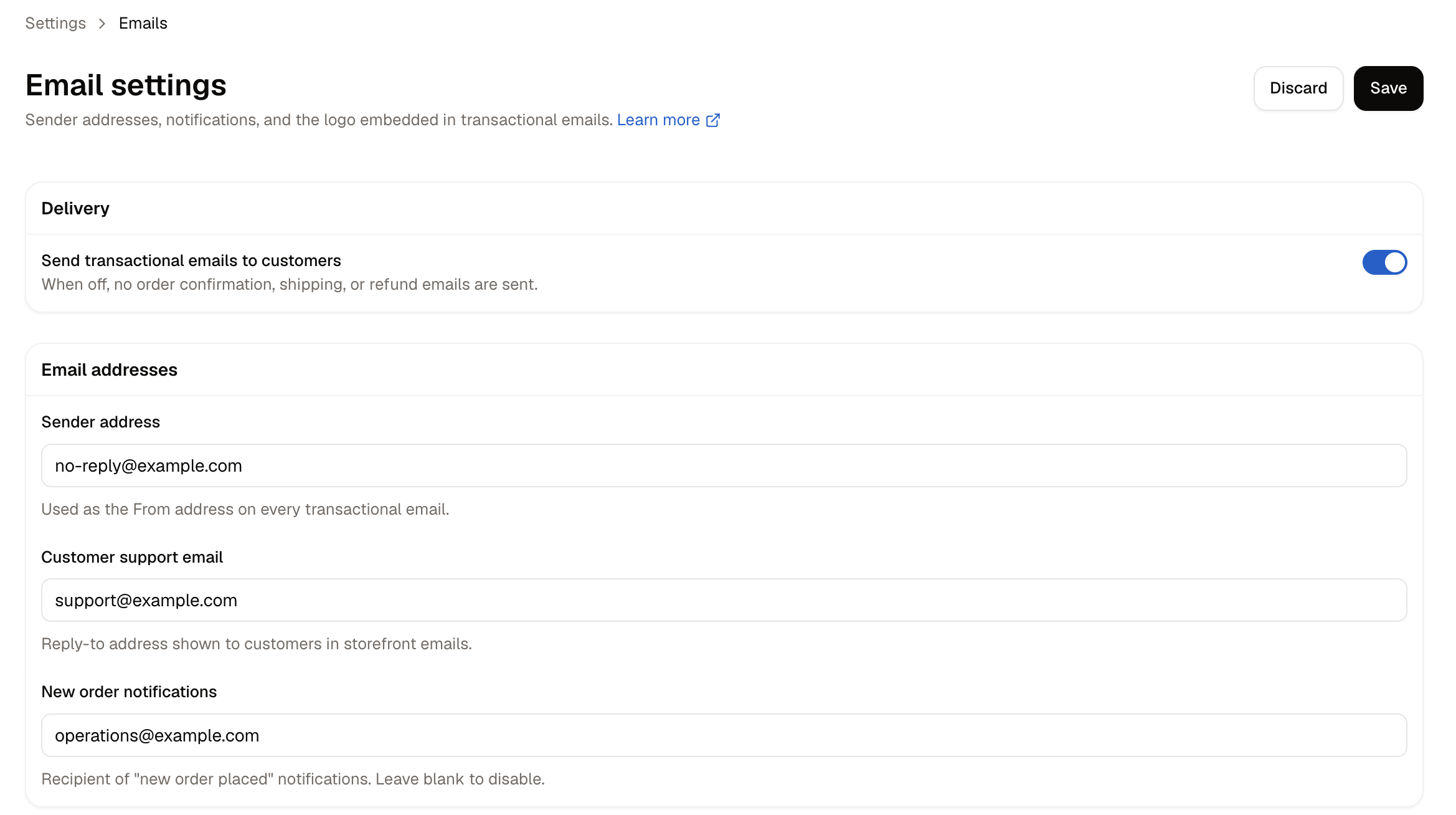
Delivery
Whether your store emails customers at all.- Send transactional emails to customers - When off, no order confirmation, shipping, or refund emails are sent.
Email Addresses
Three addresses doing three different jobs. Each is worth setting deliberately, because they appear in different places and confusing them is easy.- Sender address - The From address on every transactional email. This is what a customer sees the message arrive from, so use an address at your own domain rather than a personal one.
- Customer support email - The reply-to address shown to customers in storefront emails. When a customer hits reply, this is where it goes, so it needs to be a mailbox somebody actually reads.
- New order notifications - Where “new order placed” notifications are sent. Use an internal address your team monitors, or leave it blank to turn those notifications off.
Sender address and Customer support email are often different on purpose. Mail goes out from a no-reply address, and replies are routed to a support inbox.
Logo
The image embedded in the header of transactional emails.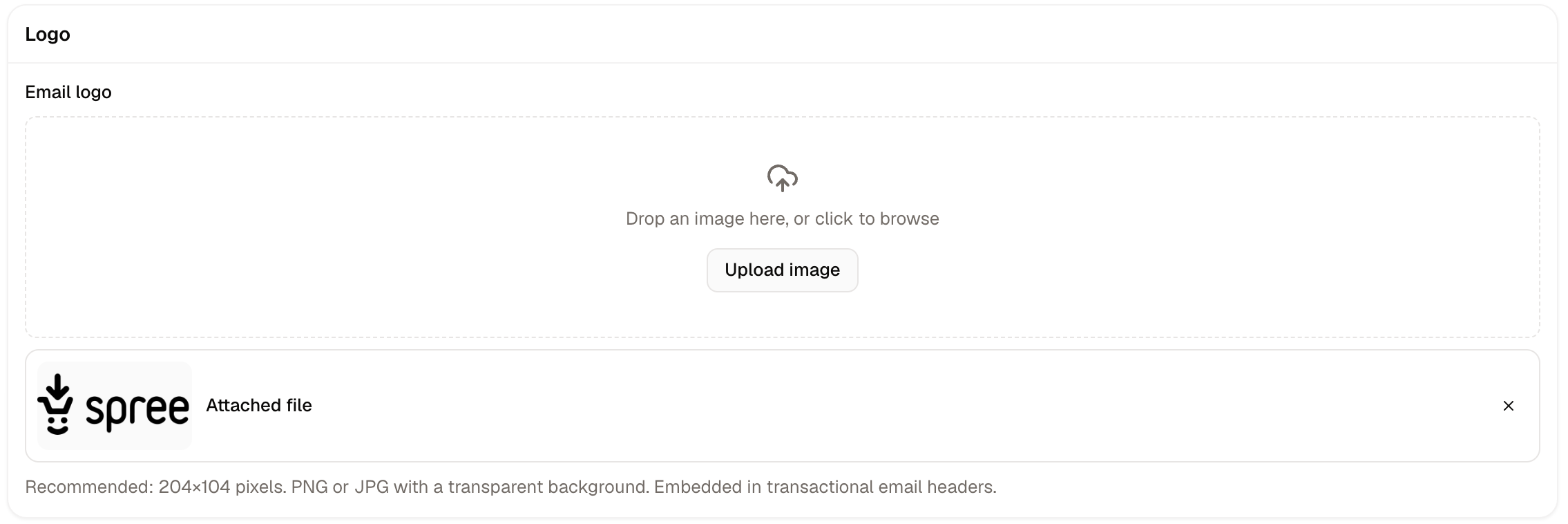
A transparent background matters more here than elsewhere, because email clients render backgrounds differently and a logo with a white box around it will look wrong against a coloured header.
Branding
The colors and font of every email your customers receive. Changing them restyles all of those emails at once, without editing any template, and they stay when you revert a template to Spree’s default.- Accent color - Buttons and links. Leave it empty to keep Spree’s outlined buttons. Button text turns black or white, whichever reads better on your color.
- Background color - Around the email.
- Card color - Behind the email’s content.
- Text color and Heading color - Body text, and headings and amounts.
- Font - Choose from fonts that display well in email apps. Web fonts, like Roboto, fall back to a similar standard font in email apps that do not load them.
Saving Changes
Click Save at the top of the page. The button stays greyed out until you change something.Templates
Open the Templates tab to change what your customers’ emails say and how they are laid out. You can edit:- each email your customers receive, such as the order confirmation, shipping notification, refund and password reset
- the layout around every customer email, with the logo at the top and the footer
- shared blocks used by several emails, such as an order’s item rows and totals
Editing templates needs the Email templates permission, which is separate from store settings, because a template changes what every customer receives.
Editing a template
Templates are written in MJML with Liquid placeholders, like{{ order.number }}, which Spree fills in for each email. As you type, the editor suggests the placeholders the email can use, and the preview shows the email filled in with one of your store’s real orders. Switch the preview between desktop and mobile, or to the plain-text version that some email apps show. To check a particular case, such as an order with a discount, enter that order’s ID in Preview with record.
Changes are saved as a draft. Customers keep receiving the published version until you click Publish, and the editor always says whether you are looking at the draft or the published version. If someone else on your team saved the draft after you opened it, Spree tells you who, so you do not overwrite their work.
Click Send test email to receive the email at your own address before publishing it.
Publishing
Publish makes the draft what customers receive from the next email on. Spree first fills the template in with your store’s data, and refuses to publish one that does not work, such as a misspelled placeholder, with the line to fix. When you publish the layout or a shared block, Spree checks every customer email that uses it. If your store has nothing to fill an email in with yet, such as no orders for the order confirmation, Spree can only check the template’s spelling and structure, so send yourself a test email once you have an order.Languages
Each language is edited separately. Choose a language in the switcher, and the template opens in that language’s words, ready to change. Customers in languages you have not edited keep receiving Spree’s own wording in their language, so an English edit never reaches your French customers in English. To make the same change in several languages, edit each one.History and reverting
Every published version is kept. Open History to see who published each one and when, and restore one into the draft to publish it again. Revert to default goes back to Spree’s own template and discards the draft. Your earlier versions stay in the history.When Spree updates a template
When an update to Spree changes a template you have edited, the editor shows Updated by Spree with what changed. Compare the two versions, then keep yours or start again from the new default, and publish the result.Further Reading
- Policies - The terms and privacy documents linked from your emails and storefront
- Roles - Who can edit email templates
- Email Templates - How your developers customize templates in code
- Sending out Emails - How your developers configure delivery and customise templates