


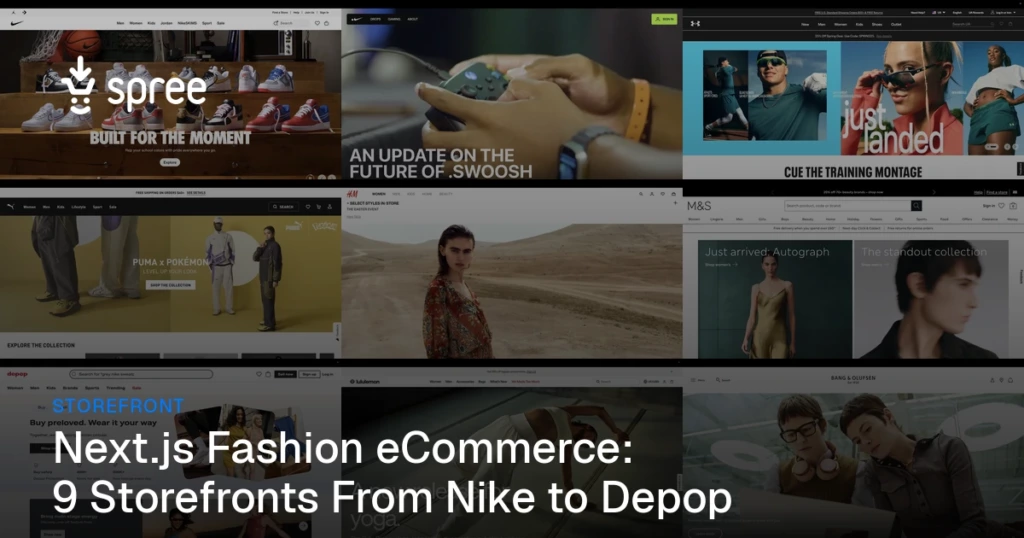
9 Amazing Next.js Fashion eCommerce Websites From Nike to Depop
Enterprise fashion brands are shipping production ecommerce storefronts on Next.js right now. Nike, H&M, Lululemon, Depop, and Bang & Olufsen have moved from SaaS platforms to headless ecommerce architecture because they need complete control over the customer experience, pricing strategy, and payment flexibility. Here’s what they’re building and how you can replicate it.

Key Takeaways
The trend: Enterprise fashion brands are moving their ecommerce to Next.js for speed, control, and global flexibility.
The examples: Nine storefronts from Nike to Lululemon, each with lessons you can apply.
Your move: An open-source backend with native multi-region, multi-currency, and zero platform fees pairs with Next.js to give fashion brands full ownership of their storefront.
Last verified: April 2026
Which Fashion Brands Run on Next.js?
Nine verified storefronts run on Next.js right now, spanning sportswear, fast fashion, premium lifestyle, and resale. Nike powers 40+ regional storefronts across DTC and digital collectibles. H&M manages rapid inventory turnover across 50+ country markets. Under Armour serves DTC and wholesale buyers from one backend with channel-specific pricing. PUMA handles multi-currency pricing and staggered global product releases.
Marks & Spencer prioritizes EU data sovereignty for its regulated retail environment. Lululemon collects first-party customer data to drive loyalty programs and personalized offers. Depop combines fashion resale with social discovery, handling both seller and buyer roles from a single account.
Bang & Olufsen runs consumer DTC and B2B commercial channels from one backend, gating the hospitality and commercial catalog behind account verification. SWOOSH demonstrates how a parent company operates two parallel storefronts with separate design systems from shared backend infrastructure. Each of these nine examples represents a distinct architecture decision worth examining in detail.
Nike
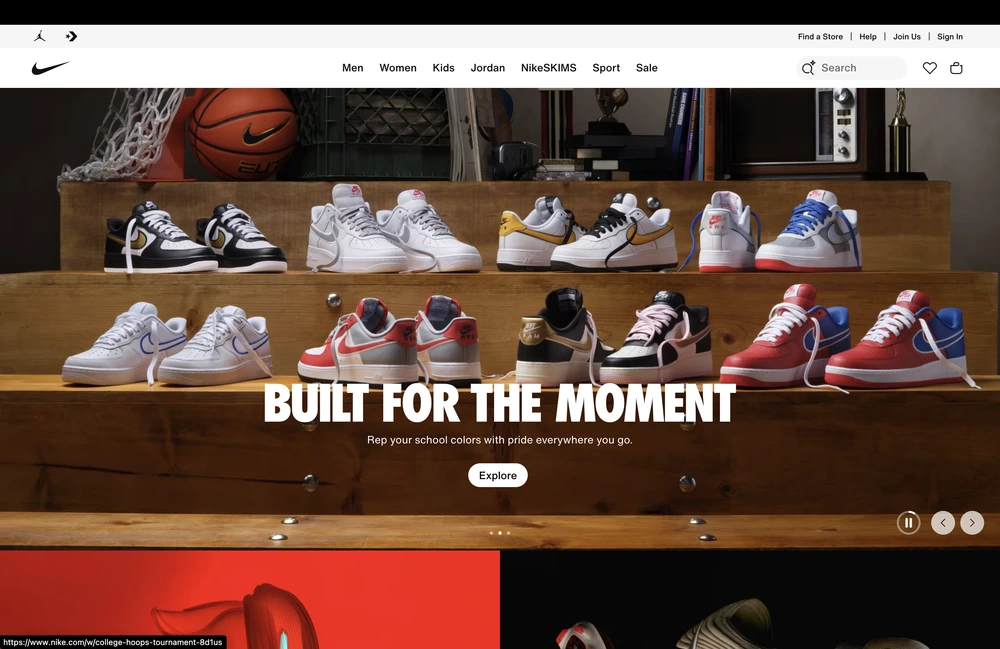
Nike’s DTC operations span 40+ countries and multiple regional storefronts. Their Next.js implementation prioritizes massive-scale product catalogs with lightning-fast image rendering and region-specific availability. Each market sees localized product recommendations, currency, and payment methods without fragmenting the backend.
Nike’s storefront demonstrates how to handle complexity at enterprise scale: thousands of product variations (size/color/width), global inventory with regional warehouses, and localized checkout experiences that vary by market. The Next.js frontend uses server-side rendering to optimize product pages for search engine crawlers and users on slow connections.
What to emulate:
- Optimized product image delivery at scale (CDN integration, responsive images)
- Region-aware product availability and SKU selection
- Fast server-side rendering for crawlable product pages
With Spree Commerce: The multi-store architecture handles region-specific pricing, currencies, and payment methods natively. Your B2B customers in one region see their negotiated prices the moment they log in, while DTC shoppers in another region see different pricing, all from the same product catalog. Same backend, completely different customer experiences across 40+ markets.
Swoosh by Nike
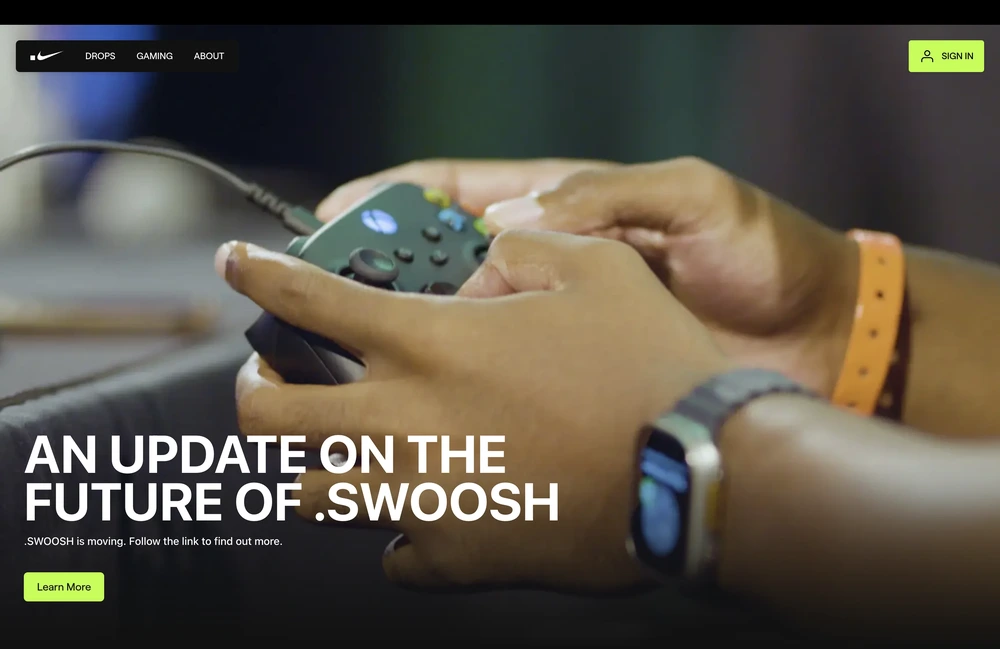
Swoosh (.SWOOSH) is Nike’s separate digital collectibles and membership platform, running on a completely different architecture than Nike.com. What’s instructive here is that a single parent company operates two parallel storefronts with different design systems, features, and business models, all powered by the same backend infrastructure.
This demonstrates how a multi-store approach scales. Nike could build Swoosh as an entirely separate system, but that duplicates payment processing, inventory, and fulfillment logic. Instead, they run Swoosh as a separate storefront connected to shared backend services, meaning changes to order management or payment processing benefit both properties.
What to emulate:
- Running multiple distinct brand experiences from one backend
- Separate Next.js storefronts sharing payment and fulfillment services
- Brand-specific customization without duplicating core commerce logic
With Spree Commerce: The multi-store module lets you run two, five, or fifty storefronts from one backend. Each store has its own catalog, branding, and pricing, but inventory and fulfillment are unified. Your payment processor handles all stores through a single account, reducing operational overhead while maintaining complete brand separation.
Under Armour

Under Armour operates both direct-to-consumer and B2B wholesale ecommerce channels from the same backend. Their DTC storefront handles retail customers, while a separate B2B portal serves team buyers and corporate accounts with completely different pricing, minimum order quantities, and approval workflows. Yet inventory is shared: when a corporate buyer orders, it draws from the same warehouse as a DTC customer.
This is the blend that matters for growing brands: DTC and wholesale coexisting on one platform without one cannibalizing the other. Under Armour’s storefront shows how to route users to the correct experience at login, apply channel-specific pricing rules, and sync inventory across both channels in real time.
What to emulate:
- Routing customer types to different checkout experiences
- Channel-specific pricing and minimum order quantities
- Unified inventory that serves both DTC and wholesale simultaneously
With Spree Commerce: Customer group segmentation and price lists let you define channel-specific rules. A wholesale customer sees net-30 pricing and MOQ rules. A DTC customer sees retail pricing. Same product catalog, two different experiences. Your Next.js storefront detects the customer type at login and renders accordingly.
PUMA
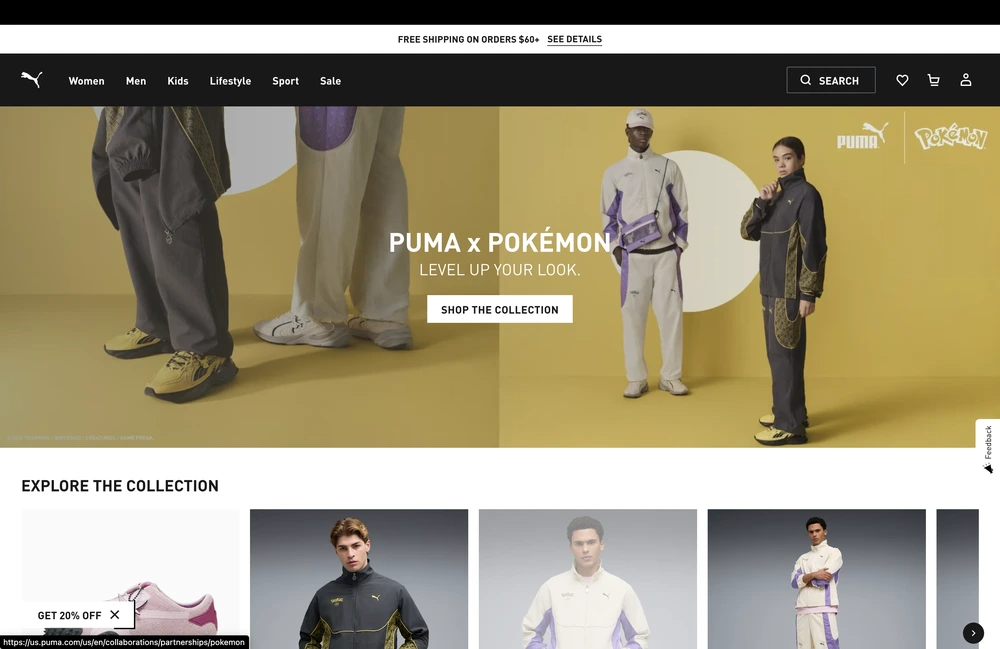
PUMA’s global storefront spans 50+ countries and handles the full complexity of multi-currency pricing, region-specific inventory, and localized payment methods. Product pages are optimized for search engines and fast load times, critical for a brand selling to price-conscious athletic shoppers globally.
PUMA’s Next.js implementation shows how to handle seasonal product releases across time zones. A new shoe launches in Asia first, then Europe, then North America. The backend manages staggered inventory, region-specific pricing adjustments based on local demand, and localized marketing campaigns without needing separate product records per region.
What to emulate:
- Multi-currency pricing with accurate exchange rate management
- Region-specific inventory allocation and warehouse routing
- Fast product pages with optimized imagery for global audiences
With Spree Commerce: Multi-region operations manage currency, shipping methods, and payment options per region. A product automatically shows the correct price in JPY, EUR, or USD based on the shopper’s location. Your Next.js frontend makes one call and receives the right data, inventory, and regional payment methods without special logic.
H&M
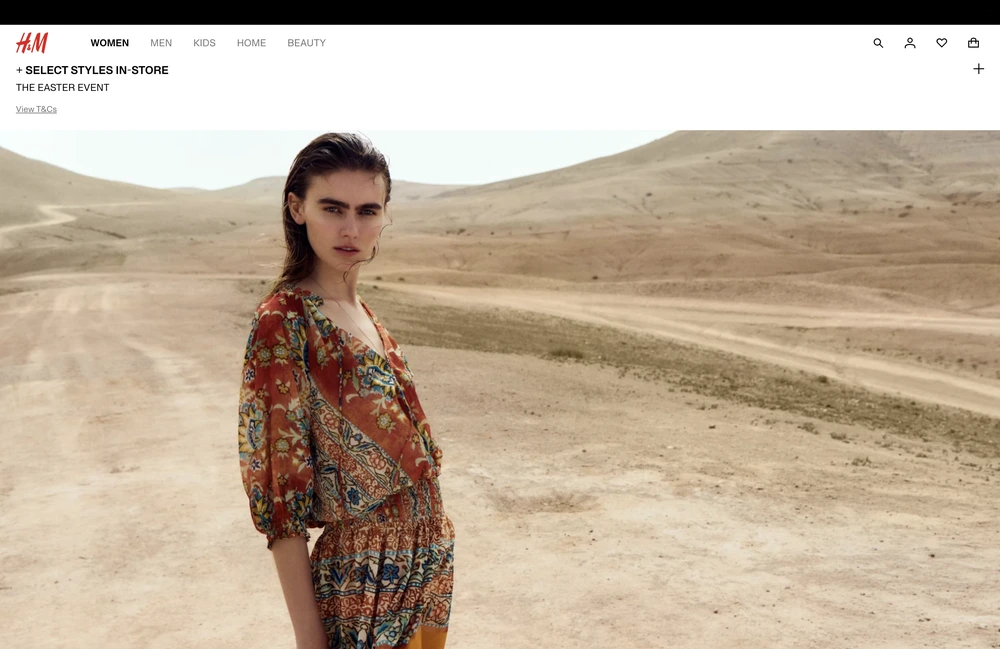
H&M runs one of the world’s largest fashion ecommerce operations, with 50+ country markets and thousands of SKUs turning over weekly. Their Next.js storefront handles rapid inventory turnover and seasonal complexity at massive scale. Products come and go quickly, sizes sell out unpredictably, and inventory must be accurate across 30+ fulfillment centers.
H&M’s architecture shows how headless commerce scales when you have both volume and velocity. Their backend manages inventory synchronization across regions in near-real-time, prices fluctuate based on inventory aging and seasonal demand, and the storefront reflects those changes instantly without requiring deployment.
What to emulate:
- Real-time inventory visibility across global fulfillment centers
- Dynamic pricing based on inventory aging and seasonality
- Fast-moving SKU management with rapid product lifecycle turnover
With Spree Commerce: Stock management tracks inventory across multiple locations and updates in real time. Customer-specific price lists can be rule-based, allowing dynamic pricing by season or stock level. Your Next.js storefront queries current stock and pricing without caching concerns, so customers always see accurate availability and real-time price changes.
Marks & Spencer
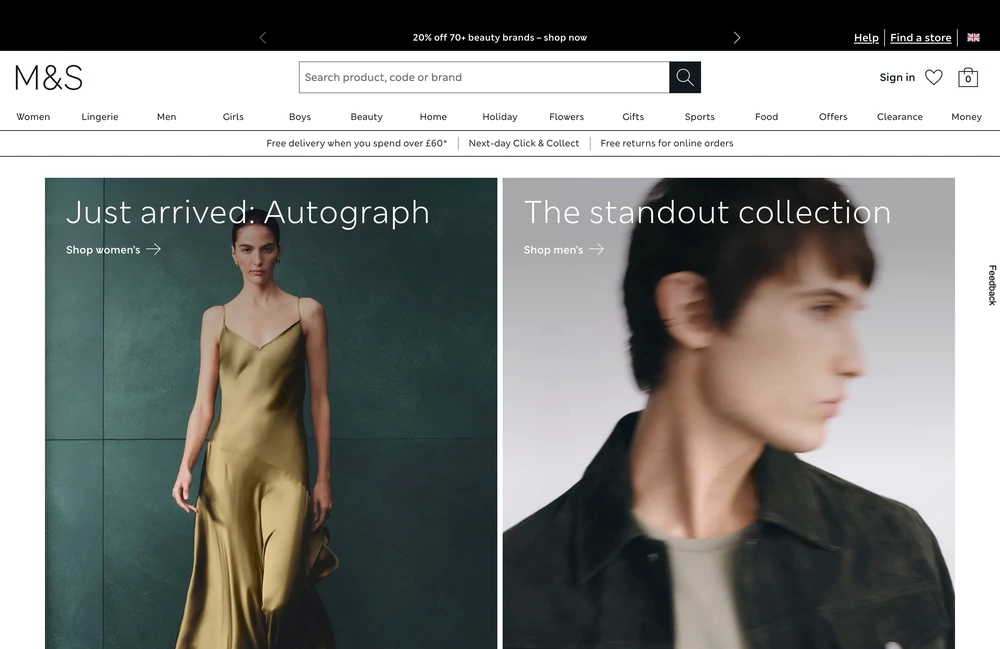
Marks & Spencer, the UK’s heritage retail icon, is refreshing their digital presence with a modern Next.js storefront. A key driver is data sovereignty and full infrastructure control. As a public company operating in the EU, they need absolute certainty about data residency, compliance with GDPR and NIS2, and the ability to audit every line of code running their platform.
M&S demonstrates why open source matters for regulated enterprise brands. They can deploy Spree Commerce on European cloud infrastructure (AWS EU, Google Cloud EU), audit the source code, and maintain complete control over customer data. No US data centers. No SaaS vendor access to personal information.
What to emulate:
- EU data residency for privacy and compliance
- Transparent, auditable codebase for regulated industries
- Self-hosted infrastructure under complete organizational control
With Spree Commerce: The open-source BSD 3-Clause license means you can deploy on your own servers in the EU, UK, or any region required by your regulators. The security-hardened architecture is transparent and auditable. No platform vendor access to customer data, no third-party processors touching regulated information without your explicit control.
Depop
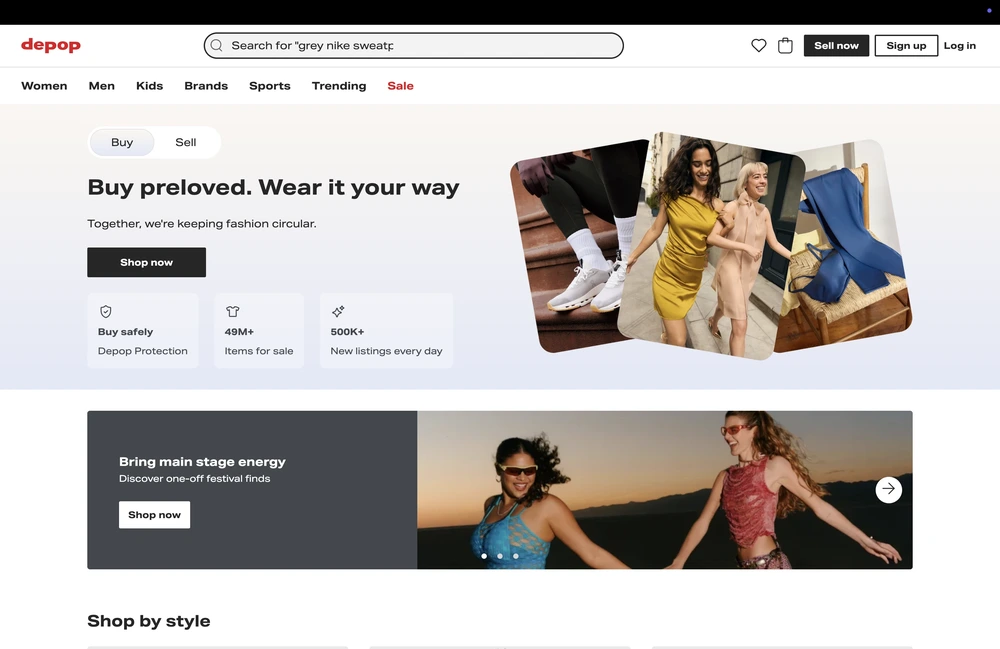
Depop is a fashion resale marketplace built for mobile-first discovery, with 35+ million registered users browsing and selling secondhand clothing, vintage pieces, and streetwear across 150+ countries. The platform’s Next.js storefront blends the visual language of social media with peer-to-peer commerce: a scrollable feed of unique items, seller profiles with follower counts, and one-tap checkout that keeps impulse purchases frictionless.
What sets Depop apart architecturally is the seller-buyer duality. Every user is simultaneously a potential buyer and seller. The same Next.js storefront adapts dynamically based on authenticated role: sellers see analytics dashboards, active listings, and payout history. Buyers see purchases, active offers, and saved items. No separate storefronts. No code duplication.
What to emulate:
- Social discovery feed that surfaces items by follower activity, trending styles, and location rather than traditional catalog ranking
- Seller/buyer role switching from a single account without separate storefronts or login flows
- In-storefront offer negotiation: “Make Offer” routes price discussion without leaving the product page
With Spree Commerce: The multi-vendor marketplace module handles seller onboarding, commission management, and payouts through Stripe Connect. Customer Segments differentiate buyer and seller behavior within the same account. The Store API powers the social feed by sorting products via custom signals rather than standard catalog ordering.
Lululemon

Lululemon is a DTC-first premium apparel brand that owns 100% of customer data and uses it to power proprietary personalization and loyalty programs. Their Next.js storefront connects to a sophisticated customer data platform that tracks purchase history, browsing behavior, and lifestyle data to drive personalized recommendations and exclusive offers.
Lululemon’s architecture proves why data ownership matters for premium brands. They’re not renting access to their customer database from a SaaS vendor. They own it entirely. Every purchase, every click, every loyalty point is first-party data that feeds their personalization engine, marketing programs, and product development decisions.
What to emulate:
- First-party customer data collection and utilization
- Personalized product recommendations driven by purchase history
- Loyalty program integration with real-time offer personalization
With Spree Commerce: The REST API provides complete customer data and order history. Your Next.js storefront can power personalization and loyalty features without losing data to a third-party vendor. Webhooks and event subscriptions let you hook custom logic into purchases, logins, and other customer actions to fuel your data platform, all under your control.
Bang & Olufsen

Bang & Olufsen sells premium audio and home electronics through a DTC storefront that operates more like a luxury fashion house than a consumer electronics retailer. Their Next.js storefront is built around the premium purchase experience: immersive product pages with film-quality video, curated collections, and a personalization service for custom color and material finishes.
The architecture challenge B&O solved is the same one luxury fashion brands face: how to maintain brand prestige online while supporting both DTC consumer sales and a separate B2B commercial channel (hotel installations, hospitality contracts, office outfitting). Their Next.js frontend serves both audiences from one backend, with the commercial channel gated to verified B2B accounts.
What to emulate:
- Immersive editorial product pages that prioritize brand storytelling alongside conversion
- B2B commercial channel running parallel to DTC consumer sales from one backend
- Customization configurator: buyers select color, material, and engraving without pre-computing thousands of SKU combinations
With Spree Commerce: Multi-store capabilities separate consumer and B2B commercial storefronts while sharing one backend. Product configurators map to flexible Option and Variant systems. Gated storefronts restrict B2B pricing and bulk ordering to verified hospitality and commercial accounts. Zero platform fees protect the margins that fund product craftsmanship.
Why Are Fashion Brands Choosing Next.js for eCommerce?
Fashion retail operates on high gross margins, but platform fees erode them fast. A brand doing $100M in annual revenue and paying 2-3% platform fees plus 2.2-3% payment processing is losing $4-6M per year to platform providers instead of reinvesting in product development, marketing, or profit. That’s the financial trigger that pushes brands toward Next.js and open-source backends. See zero platform fees for how this works.
But it’s not just about fees. Fashion is image-heavy, geo-complex, and inventory-intensive. A Next.js storefront with server-side rendering delivers product page performance at scale. Multi-region inventory and pricing require native backend support, not patchwork third-party plugins. And B2B wholesale ecommerce runs alongside DTC, with completely different pricing and approval workflows.
SaaS platforms like Shopify Plus can’t deliver all of this without add-ons and workarounds. That’s why enterprise fashion brands are building Next.js storefronts on headless ecommerce backends like Spree Commerce. The tradeoff is clear: you manage your own infrastructure, but you get complete control over margin, data, and customer journey. For fashion brands at $50M+ GMV, that tradeoff is increasingly straightforward.
There is also an ideological alignment. Next.js is open source under the MIT license, which means no vendor lock-in on the frontend. Pair that with Spree Commerce’s BSD 3-Clause license on the backend, and you have a fully open-source commerce stack. Fashion brands auditing their technology dependencies increasingly prefer this transparency over proprietary SaaS black boxes.
How Do You Build a Next.js Fashion eCommerce Storefront?
You don’t need to reinvent the wheel. Spree Commerce publishes a production-ready Next.js eCommerce starter on GitHub that you can fork and customize. It connects to a Spree Commerce REST API, giving you everything: catalog management, multi-region pricing, payment processing, inventory, and checkout out of the box.
The stack is straightforward: Spree Commerce handles the backend (products, pricing, inventory, orders, payments). Next.js handles the frontend (design, performance, user experience). You own the storefront code and data. You pick your payment gateway, from Stripe to Adyen. Zero platform fees. Start with the reference implementation, customize it for your brand, and launch in weeks instead of months.
Typical customization covers three areas: visual design (your brand system applied to reference components), business logic (pricing rules, discounts, loyalty), and integrations (payment processor, shipping, ERP). Each of the nine brands in this post went through this process. The reference implementation gets you past zero-to-one. Your team focuses on what makes your brand different, not rebuilding checkout.
Visit the open-source Next.js eCommerce storefront on GitHub to fork the starter kit and connect it to Spree Commerce’s REST API.
More Next.js eCommerce Deep Dives
This post is part of a series exploring how real brands use Next.js for ecommerce across different verticals. Each post examines verified production storefronts, breaks down the architecture decisions behind them, and shows how to replicate their approach with an open-source backend.
For marketplace-specific architecture covering multi-vendor checkout, commission splits, and real-time inventory across sellers like DoorDash, StockX, and Faire, see Next.js Marketplace: 14 Platforms From DoorDash to StockX. For B2B wholesale portals with buyer organizations, approval workflows, and contract pricing from brands like Staples, Caterpillar, and HashiCorp, see Next.js B2B: 7 Storefronts From Staples to HashiCorp.
The parent post covering all verticals is 15 Amazing eCommerce Websites Built with Next.js. If you want to build your own, start with the hands-on tutorial: Build a Next.js Ecommerce Storefront with Spree Commerce. The tutorial walks through connecting a Next.js frontend to Spree Commerce’s REST API, setting up product pages with server-side rendering, and deploying to production.
Get Started with Spree Commerce 5.4
Spree Commerce 5.4 ships a production-ready Next.js storefront, a TypeScript SDK, and a one-command installer. Every fashion storefront pattern described above now ships as a single deployable package.
What changed with Spree Commerce 5.4 for Next.js storefront builders:
- One-command install via
npx create-spree-appscaffolds a full Spree backend + Next.js storefront in minutes. - TypeScript SDK (
@spree/sdk) with autocomplete replaces manual API calls with typed, safe integrations. - Next.js eCommerce storefront ships with React-rendered transactional emails, native MeiliSearch search, dynamic breadcrumbs, multi-sitemap, robots.txt, privacy/consent, mobile-responsive design, and color swatch filters.
- AI-assisted development with AGENTS.md and an MCP server means Claude Code, Cursor, and Copilot understand the Spree codebase from day one.
- Multi-language and multi-region URL routing built into the storefront for cross-border eCommerce from launch.
- Live demo at demo.spreecommerce.org shows the production storefront running against a real Spree backend.
Frequently Asked Questions
How do you build a Next.js fashion ecommerce storefront?
Start with an open-source commerce backend like Spree Commerce and its reference Next.js storefront. The backend handles catalog, pricing, inventory, and checkout. Your team customizes the Next.js frontend for your brand’s design system. Most fashion brands launch in 4-8 weeks using this approach.
Is Next.js good for ecommerce websites?
Yes. Next.js combines server-side rendering for SEO, static generation for speed, and API routes for dynamic features like real-time inventory. Nine of the fashion brands in this post chose Next.js specifically because image-heavy product pages load faster with server-side rendering than with client-side JavaScript frameworks.
What is headless commerce for fashion brands?
Headless commerce separates the storefront (what shoppers see) from the backend (products, pricing, orders). Fashion brands choose headless architecture because it lets them redesign the shopping experience without touching inventory or payment logic. Nike runs 40+ regional storefronts from one backend using this approach.
How does open source ecommerce compare to Shopify for fashion?
Open source gives you full control over pricing, data, and payment processing with zero platform fees. A fashion brand doing $100M annually saves $2-3M per year by eliminating percentage-based transaction fees. The tradeoff is managing your own infrastructure, which is increasingly straightforward for brands at $50M+ GMV.
Can you run DTC and wholesale from one Next.js storefront?
Yes. Spree Commerce’s Customer Segments and Price Lists let you serve retail and wholesale buyers from a single backend. Under Armour does exactly this: DTC customers see retail pricing while wholesale accounts see negotiated rates, minimum order quantities, and approval workflows. Same product catalog, two experiences.
What payment providers work with a headless Next.js ecommerce store?
Any processor with a REST API. Spree Commerce integrates natively with Stripe, Adyen, PayPal, and others through a unified Payment Sessions API. Fashion brands operating globally typically start with Stripe, then add Adyen for region-specific methods like iDEAL (Netherlands) or Alipay (China) without rewriting the storefront.
Why are enterprise fashion brands moving away from SaaS ecommerce platforms?
Margin pressure. When you operate at 40-60% gross margins and pay 2-3% platform fees plus payment processing on every transaction, the costs compound fast. Enterprise fashion brands want full data ownership, the ability to customize every checkout interaction, and zero per-transaction fees. Headless open-source stacks deliver all three. Fork the Next.js eCommerce storefront on GitHub and run npx create-spree-app to scaffold a full store in minutes. Next.js storefront install guide (deploy on Vercel). Ready for enterprise? Get started with Spree Commerce.