


7 Real-World Next.js B2B eCommerce Websites From Staples to HashiCorp
The B2B ecommerce market is projected to hit $36 trillion by 2028, but most buyers still tolerate slow catalogs, clunky approval workflows, and outdated portals. Seven enterprise brands already run their B2B and wholesale storefronts on Next.js: Staples, AT&T, Faire, Caterpillar Parts, LG, Bang & Olufsen, and HashiCorp, each delivering the speed and UX that B2B buyers now expect.

Key Takeaways
The market: B2B ecommerce is a $36 trillion opportunity, and buyers now expect the same speed and experience they get from consumer storefronts.
The examples: Seven storefronts spanning office supplies, telecom, wholesale marketplaces, and industrial distribution.
Why it matters: Buyer organizations, approval workflows, custom price lists, and gated storefronts are native features in Spree Commerce, paired with Next.js for enterprise buyer portals you fully own.
Last verified: April 2026
Direct-to-Distributor Storefronts
Staples Business
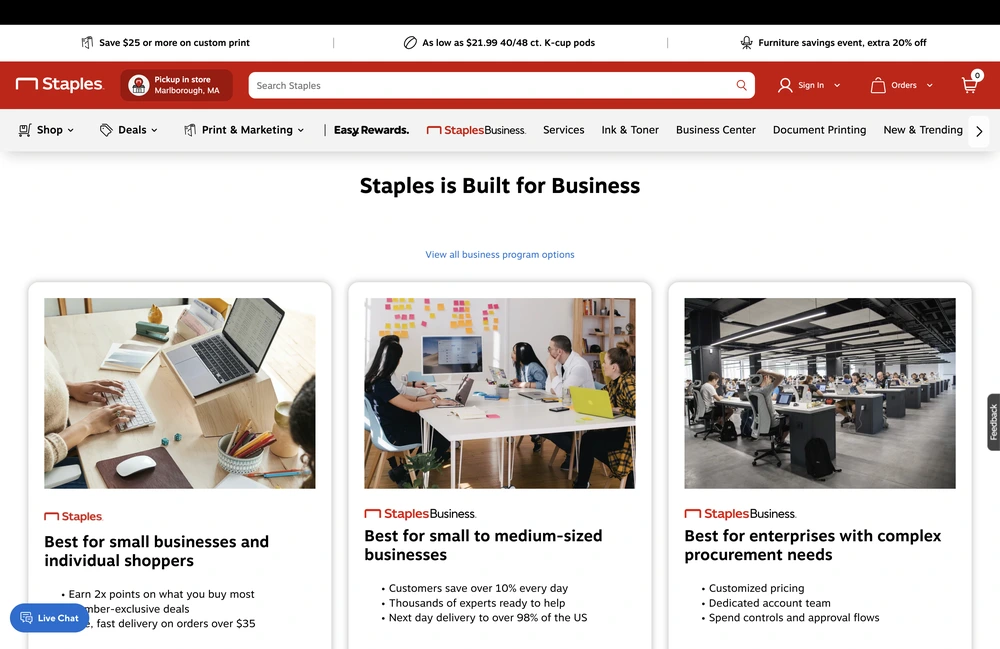
Staples runs separate portals for office supply retail and B2B wholesale, serving millions of small business and enterprise buyers. The Staples Business storefront is a masterclass in B2B ecommerce at scale. It handles 2+ million products, enterprise contract pricing, bulk ordering, and complex account hierarchies (corporate, department, and employee permissions). Deep integrations with procurement systems like Ariba and Coupa complete the offering.
A Fortune 500 company with Staples as an approved supplier can log in, see their negotiated bulk pricing immediately, configure multi-department accounts with spending limits per employee, and place recurring orders without re-entering data. The storefront is fast because Staples knows that a buyer comparing Staples Business to a competitor will switch if one loads 3 seconds faster.
What to emulate: Staples shows how to serve both B2C and B2B from a single platform without letting one experience cannibalize the other. Each buyer type sees different pricing, different product selections, and different workflows, but they browse the same 2+ million product catalog. The system never gets confused about who is buying or at what rate.
With Spree Commerce: Customer groups differentiate B2C retail from B2B wholesale buyers. Pricing and catalog visibility are controlled per segment without code duplication. Tiered pricing per buyer account assigns contract rates with volume discounts (order 100+ reams, get 15% off). Gated storefronts show business-only products and require verification before checkout access.
Store roles allow parent account admins to create sub-accounts with delegated spending authority. Multi-store architecture means you can run Staples.com and Staples Business as separate front-ends sharing the same inventory, order, and customer database.
Caterpillar Parts (parts.cat.com): Pure B2B Parts Commerce
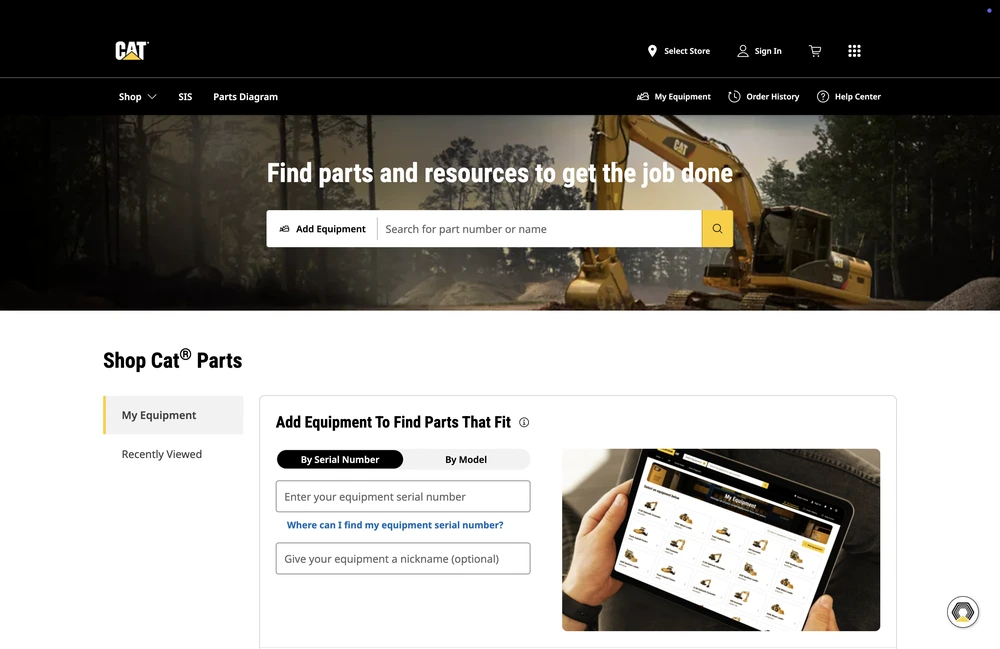
Caterpillar’s parts division operates one of the largest B2B industrial ecommerce storefronts in the world, selling 1.5+ million part numbers to equipment owners, dealers, and fleet operators worldwide. The parts.cat.com storefront runs on Next.js because finding the right part for a machine is a complex search problem, not a browsing problem.
A mine operator with a fleet of 200 excavators logs in and needs a specific hydraulic seal for a Cat 390F L. They do not browse a catalog. They enter the machine serial number. The storefront retrieves the exact parts diagram for that specific configuration and displays only the parts that fit. The wrong part never ships.
What to emulate: Caterpillar shows how to serve parts-based B2B commerce where machine-specific fitment data drives the entire catalog experience. Parts that do not fit are never shown. Approved buyers see contract pricing for their fleet accounts. Dealers see wholesale pricing and allocation data from a single login.
With Spree Commerce: Product properties store machine compatibility data (model, serial number range, configuration). The Store API with filtering narrows catalog results by machine specification across millions of SKUs in milliseconds. Wholesale pricing per dealer tier assigns contract rates. Gated storefronts restrict bulk dealer pricing to verified Cat dealer accounts.
Enterprise Technology & Services Storefronts
AT&T Enterprise Sales Portal

AT&T operates a duality: consumer storefronts for retail customers and enterprise procurement portals for corporate accounts. The enterprise side handles multi-location service orders, contract pricing, volume commitments, and usage-based billing. It is not a typical storefront. It is a configuration engine paired with compliance and quoting workflows.
What to emulate: AT&T shows how to handle service-based B2B commerce on the same platform as product sales. Configuration matrices, pricing that adapts to contract terms, and approval workflows embedded in the ordering process are all essential.
With Spree Commerce: Multi-store architecture lets you run consumer and enterprise storefronts as separate experiences sharing the same backend. Custom pricing per enterprise contract handles volume and term-based rates. Buyer organizations with role-based permissions route orders to procurement managers before fulfillment. Custom checkout flows integrate quoting and configuration selection. Webhooks alert CRM systems and fulfillment teams.
LG Business Solutions

LG’s business division operates a dedicated B2B storefront serving corporate, hospitality, healthcare, and education buyers with a separate product catalog and pricing from the LG consumer site. The storefront sells commercial displays, digital signage, medical-grade monitors, and enterprise hardware, each category with distinct purchasing workflows and compliance documentation.
A hospital procurement team ordering 200 clinical monitors sees different products, different certifications (FDA Class II medical device status, DICOM compliance), and different pricing than a consumer buying the same LG display for home use. The storefront enforces these distinctions automatically: account type determines catalog access, pricing tier, and available payment terms.
What to emulate: LG Business shows how to run a parallel B2B operation alongside a high-volume consumer brand without letting one experience contaminate the other. Product catalog access, compliance metadata, pricing, and checkout workflows are all buyer-type-dependent.
With Spree Commerce: Customer group segmentation differentiates consumer and B2B account types. Product properties store compliance and certification metadata (FDA clearance, DICOM compliance, energy certification) as native product attributes. access-controlled B2B portal require business account verification before exposing commercial pricing and restricted product categories.
HashiCorp: B2B SaaS Self-Service Purchasing
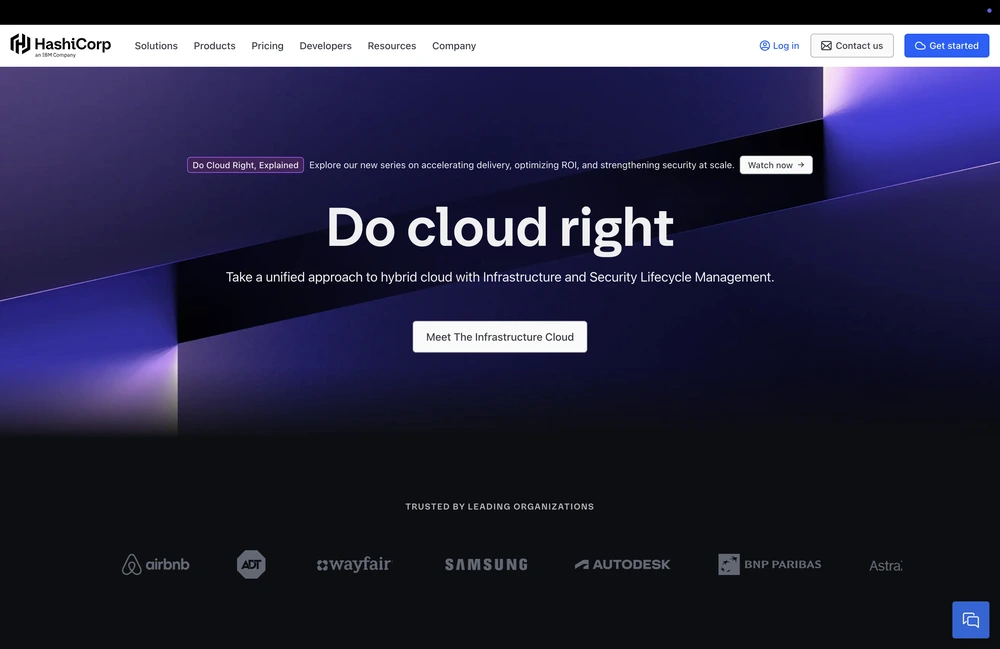
HashiCorp (now part of IBM) offers self-service purchasing for enterprise infrastructure software: Terraform, Vault, Consul, and Nomad. Their Next.js storefront handles the complete B2B SaaS buying journey, from free tier activation to enterprise contract purchasing, without requiring a sales call for the majority of customers.
A DevOps team evaluating Terraform Cloud starts with a free account. When usage scales, the storefront surfaces upgrade prompts with pricing calculators tied to their current resource consumption. The upgrade path from developer tier to business tier to enterprise contract is entirely self-service, with the storefront rendering the correct options, billing changes, and legal agreements for each transition.
What to emulate: HashiCorp proves that B2B software companies can replace the “contact sales” gate with self-service purchasing without losing enterprise deal quality. The storefront must handle usage-based pricing, seat count changes, and contract upgrades natively.
With Spree Commerce: Subscriptions module manages recurring billing with flexible tier upgrades and usage-based pricing adjustments. Segment-specific pricing tiers handle developer, business, and enterprise contract rates. Buyer organizations with role-based permissions route high-value tier upgrades to account executives while keeping smaller upgrades fully self-service. Webhooks trigger provisioning systems the moment a purchase completes.
How Are Wholesale Marketplaces Scaling on Next.js?
Faire: The B2B Marketplace Standard

Faire is the largest wholesale ecommerce portal for independent retailers, handling $12 billion in annual volume across 700,000 retailers and 1 million+ sellers. On Faire, a boutique candle maker lists products, and a small retailer anywhere on Earth can order in minutes, with flexible minimum order quantities, net payment terms (typically net-30), and automatic inventory management.
Faire’s Next.js-powered storefront is deceptively complex: product filtering by retailer profile and location, personalized pricing based on order history, net payment terms orchestration, supplier performance scoring, reorder workflows, and marketplace messaging. It sets a benchmark for B2B marketplace UX.
What to emulate: Faire shows that a marketplace combining thousands of sellers with thousands of buyers demands B2B-specific features. Minimum order enforcement, net payment terms, buyer reputation scoring, and bulk reorder capabilities are what drive repeat usage and higher order frequency.
With Spree Commerce: Multi-vendor marketplace module (native in Community Edition) provides multi-vendor order management and automated payouts via Stripe Connect. B2B features (Enterprise) add missing pieces: tiered pricing per supplier and buyer with minimums and bulk discounts. procurement team approval workflows route net-30 payment terms through finance teams. restricted business catalog require verified retailers.
Customer group segmentation surfaces different sellers and pricing to repeat buyers versus new accounts. real-time event notifications notify sellers of inventory thresholds.
Bang & Olufsen Commercial
Bang & Olufsen’s commercial division sells premium audio and video systems to hotels, restaurants, corporate offices, and retail environments, running separately from the consumer DTC storefront. The B2B Next.js storefront is gated: hospitality and corporate buyers must verify their business type and project scope before accessing commercial pricing, volume configurations, and installation service packages.
The purchase journey is also fundamentally different from consumer. A hotel group outfitting 400 rooms does not add items to a cart one by one. They configure a project: room count, product model, custom finishes, installation scope, and delivery schedule. The storefront captures this as a structured quote request, routes it to a B&O commercial sales representative, and tracks the project from quote to delivery.
What to emulate: B&O Commercial shows that B2B ecommerce for premium brands is not just a price list behind a login wall. Complex project configuration, quote workflows, and installation-based fulfillment are core buying behaviors that the storefront must support natively.
With Spree Commerce: verified-buyer-only purchasing require business account type and project scope verification before accessing commercial pricing. organizational purchasing controls route configured quote requests to sales representatives rather than triggering direct checkout. Custom checkout flows capture project specifications as order-level metadata. single-backend multi-storefront model runs consumer DTC and commercial B2B as separate front-end experiences from one backend.
Why Is B2B eCommerce Moving to Next.js?
B2B buyers are not patient. A 2025 McKinsey survey found that 73% of business buyers expect the same speed and mobile experience from B2B storefronts as they get from consumer sites. A procurement manager who browses fast, searches seamlessly, and checks out in minutes will spend more and reorder more often than one wrestling with a portal that loads in 8 seconds.
Speed is not cosmetic in B2B. Forrester Research found that procurement teams spend an average of 4.2 hours per week on manual ordering processes in legacy systems. A fast B2B storefront with quick-order workflows and saved carts cuts that time in half. Over a year, that is 200+ hours recovered per buyer. At a $75K salary, that is $14,000+ in recovered labor per customer.
Next.js delivers that speed out of the box. Server-side rendering personalizes pricing pages in real time. A buyer logging in immediately sees their negotiated rates without waiting for API calls. Incremental Static Regeneration keeps catalog data fresh without rebuilding entire pages. Image optimization slashes load times.
When paired with an API-first B2B ecommerce backend, Next.js becomes the front door to complex business logic: customer-specific pricing, approval chains, buyer organizations, and gated catalogs. All invisible to the buyer but essential to the business.
B2B workflows vary wildly. One supplier needs net-30 terms and PO matching. Another needs tiered volume pricing and parent-child buyer hierarchies. A third needs custom catalog restrictions per buyer group. A fourth must route orders through compliance review before shipping.
Open source matters for B2B. Next.js is MIT-licensed, and Spree Commerce is BSD 3-Clause. Together they form a fully auditable commerce stack with zero licensing fees. For enterprise procurement teams evaluating vendor risk, open source eliminates single-vendor dependency. Your engineering team can inspect, modify, and deploy every component without waiting for a SaaS provider to update their roadmap.
How Does Spree Commerce Enable B2B eCommerce on Next.js?
Building a B2B storefront is different from building a consumer site. Checkout is simple. Everything else is complex.
Buyer Organizations model real organizational structures. A manufacturing company with 50 locations sets up a parent account and creates sub-accounts for each location, each with their own spending authority and role-based permissions. One location’s buyer places orders up to $10K. Their manager approves orders up to $50K. Regional directors handle up to $200K. C-suite approval required above that.
Approval Workflows route orders through configurable chains of command. Orders over a dollar threshold route to a manager. Net-30 payment terms automatically route to finance before shipping. Restricted product categories (hazardous materials, controlled substances, regulated devices) route to compliance. These workflows are business rules, not code. A business administrator configures them from the dashboard in minutes.
Price Lists are the backbone of B2B operations. Volume discounts reward bulk orders: buy 1-10 units at full price, 11-50 at 10% off, 51+ at 20% off. Contract rates lock prices for high-value accounts: your biggest customer gets net-60 terms and 25% off list price.
Geographic pricing reflects local costs across warehouses in different regions. Customer-specific pricing rewards loyalty and increases lifetime value. One product SKU can have unlimited price points depending on buyer context (contract, volume, geography, loyalty tier). Spree Commerce layers multiple price lists in priority order and applies the most favorable combination automatically.
Gated Storefronts restrict visibility until account verification completes. A wholesale buyer sees a login screen, enters company name and buyer role. An admin approves or rejects the account. Once approved, restricted product categories only display to authorized buyer groups. A hospital supplier shows surgical products only to verified healthcare facilities.
Wholesale Portals accelerate reorders through quick-order grids (paste part numbers and quantities) and CSV bulk upload options. Saved cart templates standardize monthly supply orders. One-click reorder buttons reduce friction on repeat purchases. A procurement manager completes a recurring monthly order in 2 minutes instead of 30.
All of this is native to Spree Commerce. Not plugins. Not third-party add-ons. Not custom code glued together. First-party modules maintain backwards compatibility across updates and scale without fragmenting. Layer them as your business model evolves. Start with gated storefronts, add approval workflows as you grow, introduce tiered pricing for major accounts, and implement buyer organizations at 100+ customers. No re-platforming required.
Build Your B2B Storefront on Next.js and Spree Commerce
Building a B2B eCommerce storefront on Next.js and Spree Commerce gives you what no SaaS platform can offer. You get the ability to evolve your business model without re-platforming, the speed your buyers expect, and the data ownership and cost control your finance team demands.
The brands showcased here, from Staples to HashiCorp, have proven that next-generation B2B ecommerce is built by companies that own their stack, not rent it. The open-source Next.js eCommerce storefront provides a production-ready starting point. Fork the repository, connect it to Spree Commerce’s Store REST API, and deploy your first buyer-facing storefront in days rather than months. Every B2B feature covered in this post, from buyer organizations to price lists and approval workflows, is available through that same API from day one.
Fork the Next.js eCommerce storefront on GitHub to launch your B2B portal, or explore B2B eCommerce capabilities to see how buyer organizations, approval workflows, and contract pricing work out of the box. For a hands-on walkthrough, build a Next.js storefront with Spree Commerce.
More Next.js eCommerce Deep Dives
This post is part of a series exploring how real brands use Next.js for ecommerce across different verticals. Each post examines verified production storefronts, breaks down the architecture decisions worth emulating, and shows how to replicate their approach with an open-source backend.
For fashion-specific storefronts covering multi-region pricing, DTC-wholesale duality, and premium brand experiences from Nike, H&M, Lululemon, and Depop, see Next.js Fashion eCommerce: 9 Storefronts From Nike to Depop. For marketplace platforms with multi-vendor checkout, commission splits, and real-time inventory from DoorDash, StockX, Zillow, and Faire, see Next.js Marketplace: 14 Platforms From DoorDash to StockX.
The parent post covering all verticals is 15 Amazing eCommerce Websites Built with Next.js. For a hands-on tutorial, see Build a Next.js Ecommerce Storefront with Spree Commerce. The tutorial walks through connecting a Next.js frontend to Spree Commerce’s REST API, configuring product pages with server-side rendering, and deploying to production. Every brand in this series uses a variation of that same architecture pattern.
Get Started with Spree Commerce 5.4
Spree Commerce 5.4 ships a production-ready Next.js storefront, a TypeScript SDK, and a one-command installer. Every B2B feature described above now ships as a single deployable package.
What changed with Spree Commerce 5.4 for B2B storefront builders:
- One-command install via
npx create-spree-appscaffolds a full Spree backend + Next.js storefront in minutes. - TypeScript SDK (
@spree/sdk) with autocomplete replaces manual API calls with typed, safe integrations. - Next.js eCommerce storefront ships with React-rendered transactional emails, native MeiliSearch search, dynamic breadcrumbs, multi-sitemap, robots.txt, privacy/consent, mobile-responsive design, and color swatch filters.
- AI-assisted development with AGENTS.md and an MCP server means Claude Code, Cursor, and Copilot understand the Spree codebase from day one.
- Multi-language and multi-region URL routing built into the storefront for cross-border eCommerce from launch.
- Live demo at demo.spreecommerce.org shows the production storefront running against a real Spree backend.
Frequently Asked Questions
What is B2B ecommerce and how is it different from B2C?
B2B ecommerce handles transactions between businesses, not consumers. The key differences are pricing (negotiated rates, volume tiers, contract terms), purchasing workflows (approval chains, purchase orders, spending limits), and account structures (buyer organizations with multiple users and roles). Spree Commerce supports all of these natively in its B2B modules.
Can you run B2B and B2C on one ecommerce platform?
Yes. buyer-type classification routes different buyer types to different experiences from a single backend. Staples does exactly this: retail customers see consumer pricing while business accounts see negotiated bulk rates, spending controls, and procurement integrations. Your Next.js frontend renders the correct interface based on who logs in.
What features does a B2B ecommerce platform need?
At minimum: customer-specific pricing, buyer organizations with role-based permissions, approval workflows, gated catalogs, and purchase order support. Most B2B platforms also need bulk ordering tools, saved cart templates, net payment terms, and ERP integration. Spree Commerce includes all of these as native modules rather than third-party plugins.
How do approval workflows work in B2B ecommerce?
Approval workflows route orders through configurable chains of command before fulfillment. A department head might approve orders up to $50K, a regional director handles $50K to $200K, and anything above goes to the C-suite. Spree Commerce lets business administrators configure these rules from the dashboard without engineering support. Orders stay pending until the designated approver takes action.
How long does it take to launch a B2B portal on Next.js?
A straightforward wholesale portal with gated access, contract pricing, and bulk ordering launches in 8-12 weeks using Spree Commerce’s B2B modules and a Next.js starter template. Complex scenarios involving marketplace functionality, multi-level approval workflows, and ERP integrations take 4-6 months. The open-source Next.js eCommerce storefront accelerates both timelines.
Is open source B2B ecommerce production-ready for enterprise?
Yes. Spree Commerce has powered enterprise commerce since 2007. Open source provides advantages that matter specifically for B2B: your procurement and security teams can audit every line of code, your engineering team owns the deployment without vendor dependency, and there are zero per-transaction fees eating into already-tight B2B margins. Spree is also the only open-source platform with native marketplace and multi-tenant capabilities alongside its B2B modules, so you can start with wholesale and expand into new business models without replatforming. Fork the Next.js eCommerce storefront on GitHub and run npx create-spree-app to scaffold a full store in minutes. Next.js storefront install guide (deploy on Vercel). Ready for enterprise? Get started with Spree Commerce.