


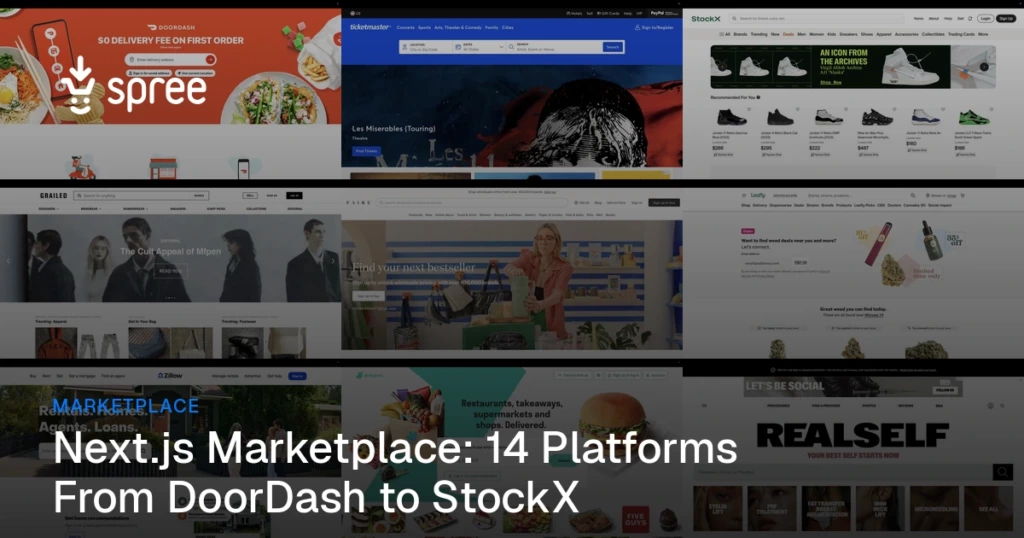
14 Amazing Next.js Marketplace Websites From DoorDash to StockX
The multi-vendor marketplace is reshaping ecommerce. Instead of a single seller moving inventory, open-source marketplace platforms connect hundreds or thousands of vendors directly to buyers, taking a commission on every transaction. Next.js has become the frontend of choice for these platforms because it handles real-time inventory updates, fast page loads across thousands of product listings, and complex multi-vendor checkout flows without breaking a sweat.

Key Takeaways
The pattern: Multi-vendor marketplaces are choosing Next.js for real-time inventory, fast page loads, and flexible checkout flows.
The examples: Fourteen platforms across food delivery, ticketing, vertical commerce, and B2B procurement.
Build yours: Spree Commerce’s Marketplace Module handles vendor onboarding, commission splits, and payouts through both Stripe Connect and Adyen for Platforms, all on an open-source backend you own.
Last verified: April 2026
Fourteen platforms already run on Next.js: DoorDash, Ticketmaster, Faire, StockX, Zillow, Grailed, Depop, and more. Each one solves a different marketplace puzzle: food delivery, ticketing, B2B wholesale, peer-to-peer resale, cannabis compliance, and vertical commerce. Each one shows what’s possible when you build marketplace ecommerce the right way.
Food & Beverage Delivery Marketplaces
DoorDash: Real-Time Inventory at Scale
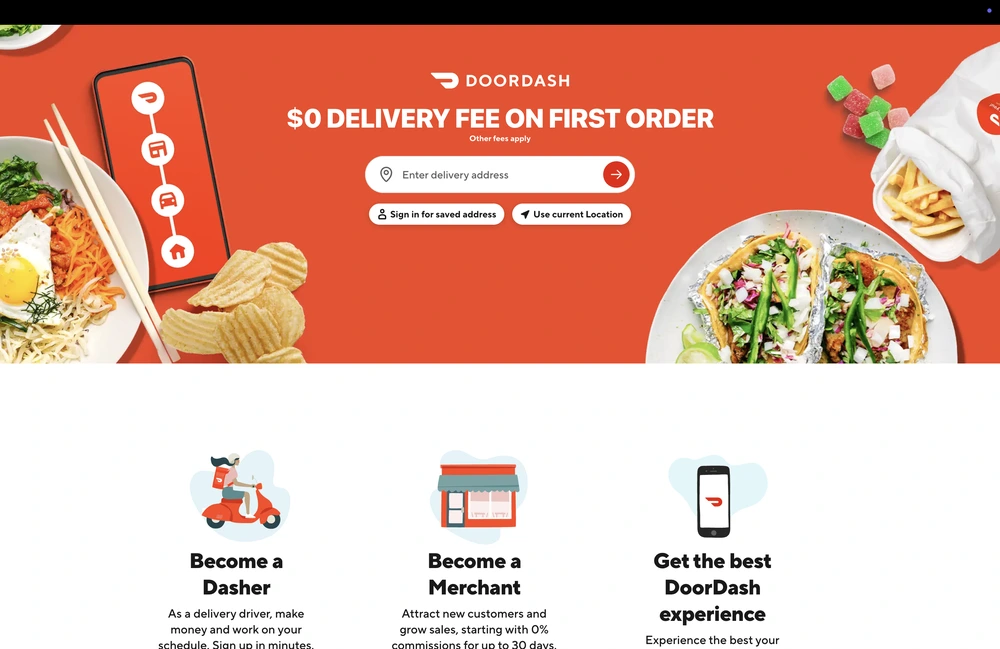
DoorDash processes $48 billion in gross merchandise value annually by connecting 1.5 million merchants to 100+ million consumers. The storefront runs on Next.js because it needs to handle real-time inventory syncing across thousands of restaurant partners simultaneously.
What to emulate:
- Real-time inventory: When a burger sells out, the menu updates across all user sessions in under 1 second. No ghost checkouts. DoorDash does this by tying each restaurant’s POS directly to the frontend, so inventory is always live.
- Fast category browsing: Users filter by cuisine, rating, delivery time, and price in under 500ms. The UX never stalls.
- Vendor promotions: Discounts, surges, and limited-time deals render instantly without requiring a full page reload.
With Spree Commerce:
The multi-vendor marketplace module handles vendor onboarding, commission management, and split payments. Each restaurant gets a dashboard to manage products and track orders. Real-time inventory syncing happens via the REST API, and commission management (DoorDash’s 15-30% take per order) calculates automatically at checkout.
Deliveroo: Multi-Region, Multi-Currency Marketplace

Deliveroo operates in 12 countries across 4 continents, handling food delivery in cities from London to Tokyo. The platform runs on Next.js to manage multi-country operations with region-specific payment methods and vendor compliance.
What to emulate:
- Vendor onboarding by country: UK restaurants verify with one set of documents. French restaurants use a different regulator. Deliveroo’s vendor signup adapts by location.
- Multi-currency checkout: A London order totals in GBP. A Tokyo order totals in JPY. The math works seamlessly.
- Demand zones: During lunch and dinner rushes, Deliveroo dynamically adjusts restaurant visibility and surge pricing by neighborhood.
With Spree Commerce:
Multi-region ecommerce operations enable per-region product availability, tax rules, and payment processors. Stripe Connect handles vendor payouts in local currencies automatically.
Eaze: Compliance-Heavy Cannabis Marketplace

Eaze operates a cannabis delivery marketplace where every transaction touches state and local compliance rules. Age verification, product restrictions, and delivery radius limits make this a regulatory maze, which is exactly why Next.js plus open-source backend works. You control every rule, auditable and transparent.
What to emulate:
- Gated access: Age verification at checkout, not signup. Customers never see products they can’t legally buy.
- Per-jurisdiction product restrictions: THC caps vary by state. Eaze’s product catalog renders differently in California versus Colorado.
- Compliance audit trail: Every order logs which products sold, to whom, and when, for state regulators.
With Spree Commerce:
Self-hosted Spree Commerce means your compliance rules stay in your code, never in a SaaS blackbox. Gated storefronts per region, webhook logging for regulators, and full data ownership ensure transparency.
Event & Ticket Marketplaces
Ticketmaster: Concurrency at Stadium Scale

Ticketmaster sells over 500 million tickets annually and handles some of the highest-concurrency moments in ecommerce. A Beyoncé ticket drop might have 500,000 users trying to buy in the first 60 seconds. Next.js powers the presale and general-sale storefronts because it never stalls under load.
What to emulate:
- Queue management: When demand exceeds inventory, Ticketmaster uses a virtual queue. Users wait their turn. Next.js plus API routes let you serve a holding page to 100,000 people without melting.
- Dynamic pricing: Prices adjust as inventory depletes. Front-row seats jump in price. Balcony seats drop. The homepage reflects this in real time.
- Event detail pages: Each event has a unique page with a venue map, seating chart, and vendor history. SEO-critical. Next.js renders these server-side so Google indexes them all.
With Spree Commerce:
The Store API handles concurrent checkout requests. Inventory updates happen in real time across all active sessions simultaneously.
DICE: Mobile-First Event Discovery
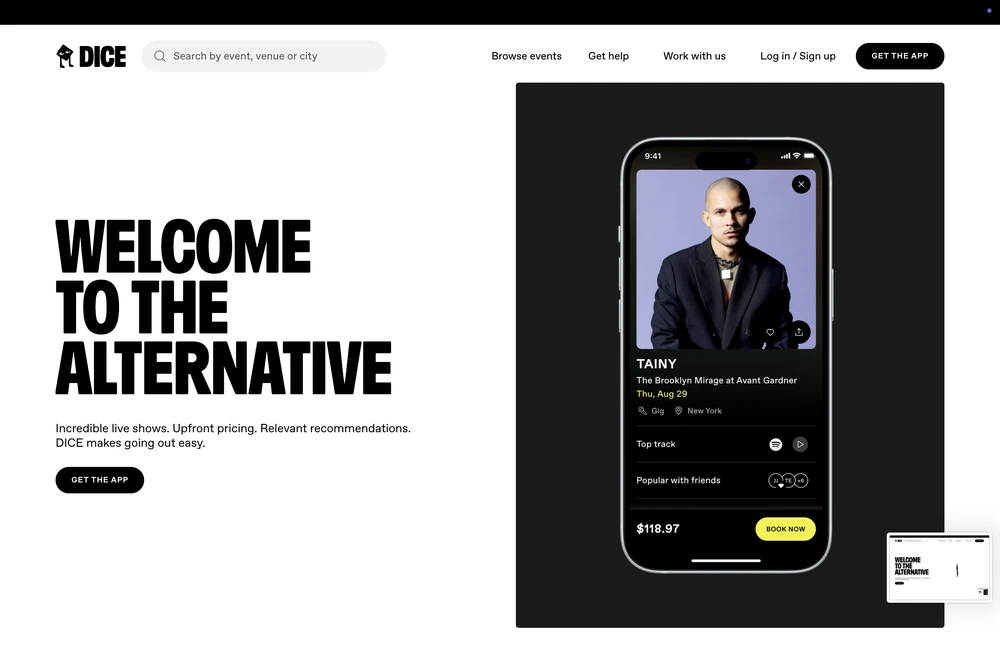
DICE is a London-based event discovery and ticketing platform serving the global music and nightlife scene. The marketplace runs on Next.js because it’s fundamentally a mobile-first experience: most users book on their phone while getting ready to go out.
What to emulate:
- Mobile checkout: Tap a few buttons and the ticket lands in your wallet. No friction. Payment sheet integration with Stripe works identically on iOS, Android, and web.
- Presale access: Artists and venues can gate early-access presales to followers or mailing list subscribers. Vendors control exactly who sees what, when.
- Real-time notifications: When a sold-out show gets a second date, DICE notifies interested users instantly. The UI updates without a refresh.
With Spree Commerce:
The REST API integrates with push notification services. Vendors can set presale rules (follower count, email list membership). The multi-vendor marketplace module tracks which vendors (artists and venues) get paid what from each ticket sale.
Resale & Authentication Marketplaces
StockX: Bid-Ask Marketplace for Authenticated Goods
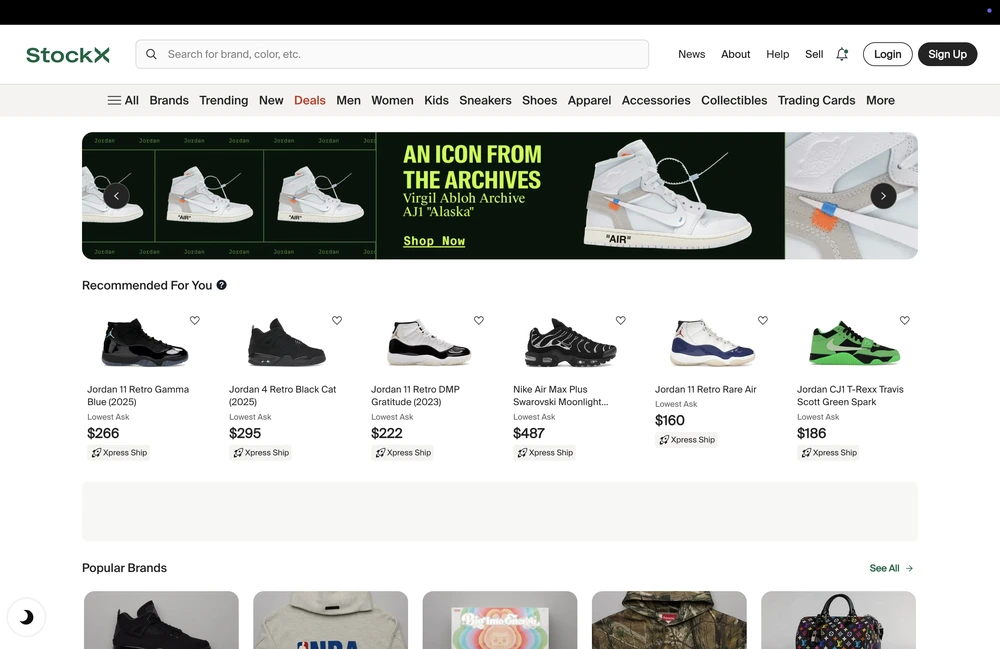
StockX operates a stock market for sneakers, streetwear, electronics, and collectibles, with a bid-ask model where buyers name a price and sellers name a price, and trades execute when they match. The platform’s Next.js storefront is a financial trading interface built on top of an ecommerce backend: live bid and ask queues, price history charts, and real-time trade execution.
What to emulate:
- Bid-ask order matching: A buyer places a bid. A seller places an ask. When they match, StockX automatically initiates the transaction, routes the item for authentication, and releases payment. The storefront updates price queues in real time.
- Authenticity guarantee: Every item passes physical inspection before reaching the buyer. Authentication is a first-class step in the purchase flow, not an afterthought.
- Price history and market data: Every product page shows price history, volatility, and trade volume. Buyers make informed purchase decisions the same way they would with any traded asset.
With Spree Commerce:
The marketplace vendor management system handles bid-ask order states (pending, matched, authenticating, shipped). Status updates push state changes to buyer and seller in real time. Automated vendor payouts via Stripe Connect holds payment in escrow during authentication, releasing to the seller only after the buyer confirms receipt.
Grailed: Curated Menswear Resale

Grailed is a peer-to-peer resale marketplace for menswear, designer clothing, and streetwear, with a tightly curated seller base that maintains quality across 5+ million listings. The platform’s Next.js storefront is built around community trust: seller reputation scores, listing photography standards, and a price-negotiation flow that keeps both parties inside the platform.
What to emulate:
- Seller reputation system: Sellers are graded on transaction speed, item accuracy, and communication. Grades surface on every listing. Buyers filter by seller reputation, which drives quality behavior without manual curation.
- Price negotiation in-platform: Buyers make offers. Sellers accept, decline, or counter. All of this happens inside the Next.js storefront without email or external messaging. The negotiation trail is logged and tied to the order.
- Curation at scale: Grailed actively removes listings that don’t meet photo or item standards. Backend tooling flags listings for admin review, processing hundreds of flags daily without slowing the storefront.
With Spree Commerce:
The marketplace commission and vendor management system tracks seller reputation scores and links them to product visibility rules. Offer flows route negotiations through an asynchronous process without requiring persistent real-time connections. Admin tools flag and queue listings for review before they surface to buyers.
Vertical Product Marketplaces
Depop: Peer-to-Peer Fashion Resale
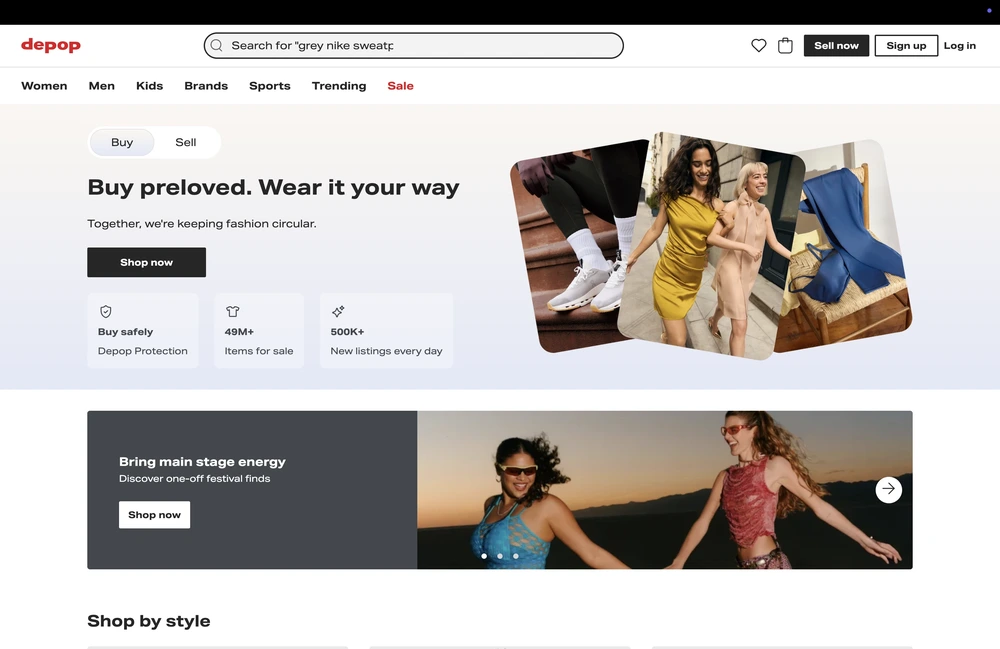
Depop is a peer-to-peer fashion resale marketplace with 35+ million registered users selling and buying secondhand clothing and vintage pieces globally. The platform runs on Next.js because its core experience is a social network and a marketplace simultaneously: a scrollable discovery feed drives the majority of purchases, and every seller is also a potential buyer.
What to emulate:
- Social-native discovery: Products surface in a feed sorted by social signals (follows, likes, trending styles) rather than standard catalog ranking. The marketplace succeeds when the feed creates impulse purchases.
- Seller-buyer role duality: Every registered user has both seller and buyer capabilities within the same account. The storefront dynamically renders dashboards, active listings, and purchase history based on which role is active.
- Commission transparency: The seller fee is displayed clearly at the point of listing, not buried in a help article. This reduces disputes and keeps the seller community trusting the platform.
With Spree Commerce:
The open-source marketplace platform handles seller onboarding, per-transaction commission calculation, and automated vendor payouts via Stripe Connect. Customer group segmentation enables seller and buyer role-switching within a single account record. The REST API powers the social feed via custom product sorting logic independent of standard catalog ranking.
Leafly: Cannabis Marketplace With State Compliance

Leafly is a cannabis marketplace and directory operating across multiple U.S. states, each with its own regulations. The platform runs on Next.js because it needs to render different product catalogs and pricing for each state without touching a monolith.
What to emulate:
- Location-based inventory: A user in California sees California-legal products and California pricing. A user in Colorado sees Colorado products. The same Next.js frontend serves both via API parameters.
- Regulatory metadata: THC caps, pesticide testing results, lab reports. All render on product pages so users can make informed choices.
- Delivery zone enforcement: Leafly shows which dispensaries can deliver to your address. If your zip code is out of bounds, that vendor grays out.
With Spree Commerce:
Multi-region ecommerce capabilities handle per-state product availability. Variants include regulatory attributes (THC percentage, terpene profile). Gated storefronts ensure only compliant orders process.
Weedmaps: Directory Meets Commerce
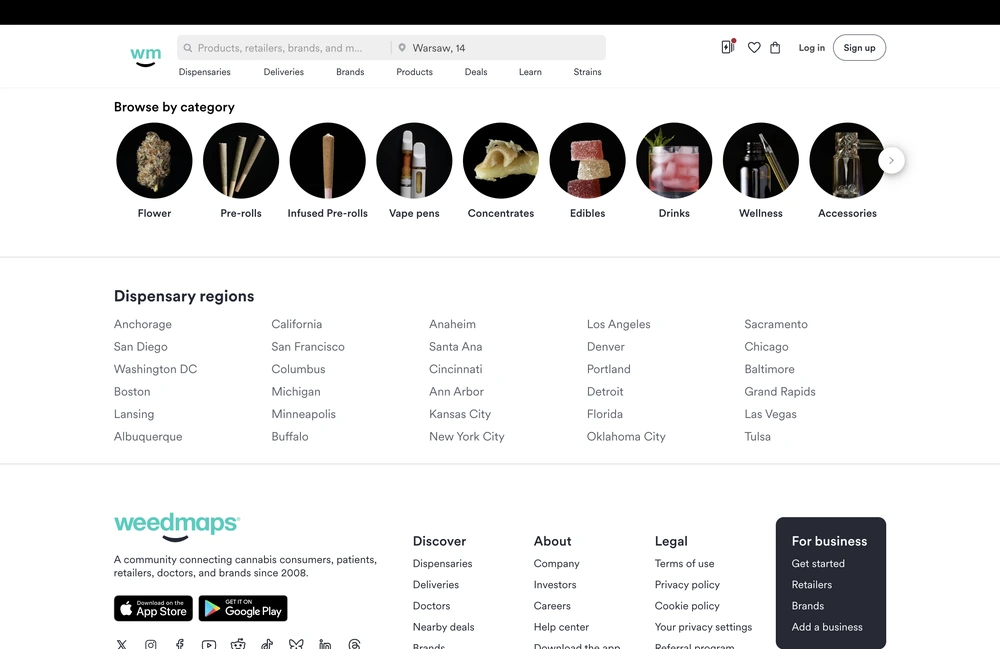
Weedmaps started as a directory (find a dispensary near you) and evolved into a marketplace where users can order directly. The storefront runs on Next.js to blend search and discovery (directory) with transactional commerce (cart and checkout).
What to emulate:
- Infinite scroll discovery: Thousands of dispensary profiles, each with reviews, hours, menu preview. Loading happens invisibly as you scroll.
- Menu at a glance: A dispensary’s product menu previews on the directory card. Click to enter their full storefront.
- Multi-vendor search: A single search query finds dispensaries and products across your region in a unified results page.
With Spree Commerce:
The Store API queries all vendor products in bulk. Faceted search filters by strain, effect, price, and THC range across all vendors. Vendor profiles live separately from inventory, linked via API.
RealSelf: Service-Based Marketplace

RealSelf is a marketplace for cosmetic and beauty services: not products, services. A user searches for board-certified surgeons in their city, reads reviews, and books a consultation. The marketplace runs on Next.js because service booking is fundamentally asynchronous: you’re not buying instantly, you’re scheduling.
What to emulate:
- Provider profiles: Each surgeon and provider has a portfolio of before-and-after photos, credentials, patient reviews, and availability calendar. Profiles are SEO-critical (people search for board-certified facelift surgeons in their city).
- Appointment booking flow: Pick a date, pick a time, confirm payment, done. The provider’s calendar updates in real time.
- Price transparency: RealSelf publishes average costs for each procedure in each city. This builds trust and reduces surprise sticker shock.
With Spree Commerce:
Spree Commerce’s flexible product types include services and bookings. Each product is a service slot. Variants are time slots. Checkout includes calendar integration. Marketplace admin dashboards let vendors manage availability.
Zillow: Real Estate Marketplace at Scale

Zillow is one of the largest real estate marketplaces in the United States, with 200 million+ monthly visitors browsing 2+ million active property listings. The platform runs on Next.js to handle complex faceted search, neighborhood-level data, and SEO-critical property detail pages at a scale that would overwhelm most storefronts.
What to emulate:
- Faceted search at scale: Filter by price, beds, baths, property type, year built, school district, walkability, and commute time. Each filter refines results instantly across millions of listings.
- SEO-critical detail pages: 2+ million property pages each ranking in Google for address and neighborhood queries. Next.js’s Incremental Static Regeneration pre-generates active listings and lazily generates the rest. Pages load in under 1 second.
- Agent marketplace layer: Every property links to agent profiles with reviews, recent sales, and contact forms. The agent earns a commission on transactions initiated through their profile.
With Spree Commerce:
Variant management models property attributes (beds, baths, lot size, year built, property type). Full-text search with faceted filters handles neighborhood and address queries across millions of listings. Marketplace admin dashboards let agents manage their listings, leads, and commission splits.
What Does a B2B Marketplace Look Like on Next.js?
Faire: B2B Wholesale at $12B Scale

Faire is a B2B wholesale marketplace connecting 700,000+ independent retailers to brands and manufacturers. The platform handles $12 billion in annual GMV and runs on Next.js because B2B ecommerce requires approval workflows, net payment terms, and complex pricing that single-vendor stores can’t touch.
What to emulate:
- Approval workflows: A boutique owner orders $5,000 of jewelry from a supplier. The order doesn’t immediately charge the card. The supplier approves the order (confirms they have inventory). Then the system charges the buyer on net-30 terms.
- Tiered pricing: A supplier might charge $10 per item for 1-50 units, $8 per item for 51-200 units, $6 per item for 200+. Faire’s pricing engine calculates the correct tier automatically.
- Quality scoring: Retailers filter suppliers by their on-time delivery rate, return rate, and product quality score. Trust is quantified and serves as a benchmark for vendor quality.
With Spree Commerce:
B2B eCommerce modules (buyer organizations, approval workflows, price lists) handle complex purchasing. The marketplace module tracks which brand got which commission per order. Multi-warehouse inventory ensures no overselling.
Inflect Global: Enterprise Procurement Marketplace

Inflect Global is a B2B procurement platform for CPG and industrial goods, serving enterprise buyers who might need to order thousands of units across multiple SKUs simultaneously. The marketplace runs on Next.js to manage bulk ordering, contract pricing, and purchase order workflows.
What to emulate:
- Bulk order entry: Type quantities for dozens of SKUs at once. No cart-add-by-add friction.
- Contract pricing: An enterprise might have negotiated prices with a vendor that differ from list price. Inflect shows each buyer the correct pricing automatically.
- PO workflows: Orders generate Purchase Orders. Invoices match POs automatically. No accounting headaches.
With Spree Commerce:
Price lists per buyer account. Bulk import via CSV. Custom order forms per vendor. REST API integrates with ERP systems (SAP, NetSuite) to sync orders downstream.
Why Do Marketplaces Run on Next.js?
Server-side rendering is table stakes. Marketplaces need thousands of product pages indexed by search engines. Each page must load in under 1 second. Next.js’s Incremental Static Regeneration pre-generates pages for active listings and lazily generates the rest. Zillow wouldn’t be searchable without it. DoorDash wouldn’t handle lunch rushes.
Checkout flexibility is critical. A food delivery marketplace charges restaurant commission. A B2B wholesale marketplace charges per-unit tiered pricing plus shipping plus taxes. A resale marketplace calculates seller fees and escrow. Next.js routes requests to the backend API without re-rendering the entire site, so payment logic and commission calculations stay in the backend, and the UI stays decoupled. You can change commission logic without redeploying the frontend.
Real-time inventory across thousands of vendors requires decoupling the frontend from the inventory database. Ticketmaster syncs seat availability in real time. DoorDash syncs restaurant menus as items sell out. Depop flags items as sold in seconds. Next.js calls REST API endpoints to fetch inventory at request time, so the UI always reflects live data without stalling.
Open-source backend power is non-negotiable for enterprises and regulated industries. Cannabis delivery (Eaze, Weedmaps, Leafly) requires auditable code for state regulators. Resale marketplaces (Grailed, Depop) need custom commission logic. B2B procurement (Inflect Global, Faire) needs approval workflows and contract pricing. A SaaS platform’s policy is a black box. Open-source code is transparent. Your team controls every rule.
How Do You Build a Next.js Marketplace With Spree Commerce?
Building a Next.js marketplace requires four components: the frontend (Next.js), the backend (API), the marketplace module (vendor management), and payments (splitting revenue). Spree Commerce provides all four.
Spree Commerce’s Marketplace Module handles vendor onboarding, commission management, and split payments out of the box. When a customer places an order, the system calculates the commission, holds the funds, and pays the vendor through Stripe Connect or Adyen for Platforms. Each vendor gets a dashboard showing their orders, revenue, and payouts. You never handle the money directly. The payment processor does, following your rules.
The commerce API layer is the backbone. Your Next.js frontend calls Spree Commerce endpoints to fetch products, place orders, and manage inventory. The API separates concerns: your frontend can change daily without touching the backend. You can power a mobile app, a Progressive Web App, and a traditional website all from the same Spree Commerce instance.
Spree Commerce’s open-source code means you own the rules. Unlike Shopify or WooCommerce, where policies are black boxes, your marketplace code is auditable. For regulated industries (cannabis, alcohol, firearms), this is non-negotiable. For enterprises, it’s power: you can customize commission logic, approval workflows, and payment routing without waiting for a SaaS provider to update their roadmap.
Getting started: Spree Commerce publishes an open-source Next.js eCommerce storefront starter template. Clone it, configure your payment processor, deploy to Vercel, and connect your vendor network. Documentation covers vendor API integrations (if your vendors have their own inventory systems), webhook configuration, and multi-region setup.
Start exploring Spree Commerce’s multi-vendor marketplace capabilities today.
What’s Next for Marketplace eCommerce?
The next 14 years of ecommerce belong to marketplaces. DoorDash, Faire, and Ticketmaster proved the model works at scale. Next.js made it possible to build fast, SEO-friendly frontends that handle millions of concurrent users. Spree Commerce provides the backend to manage vendors, commissions, and payments without reinventing them.
Start here: fork the open-source Next.js eCommerce storefront and build a small multi-vendor marketplace (10-50 vendors) to prove the model in your category. Learn where your vendors struggle (onboarding, commission clarity, payout timing). Scale to hundreds of vendors. Use what you learn to build network effects: stronger vendors attract more buyers, more buyers attract stronger vendors.
The fourteen platforms in this post share one common decision: they chose open architecture over locked-down SaaS. DoorDash could not have built real-time restaurant inventory updates on Shopify. StockX could not have built a bid-ask trading engine on WooCommerce. Zillow could not have built 2 million SEO-indexed property pages on a hosted platform. The flexibility that Next.js and open-source backends provide is not a nice-to-have. It is what made their product possible.
Your marketplace is waiting. Fork the Next.js eCommerce storefront and start building today.
More Next.js eCommerce Deep Dives
This post is part of a series exploring how real brands use Next.js for ecommerce across different verticals. Each post examines verified production storefronts, breaks down the architecture decisions worth emulating, and shows how to replicate their approach with an open-source backend.
For fashion-specific storefronts covering multi-region pricing, DTC-wholesale duality, and premium brand experiences from Nike, H&M, Lululemon, and Depop, see Next.js Fashion eCommerce: 9 Storefronts From Nike to Depop. For B2B wholesale portals with buyer organizations, approval workflows, and contract pricing from Staples, Caterpillar, and HashiCorp, see Next.js B2B: 7 Storefronts From Staples to HashiCorp.
The parent post covering all verticals is 15 Amazing eCommerce Websites Built with Next.js. For a hands-on tutorial, see Build a Next.js Ecommerce Storefront with Spree Commerce. The tutorial covers connecting a Next.js frontend to Spree Commerce’s REST API, rendering product pages with server-side rendering, and deploying to production. Every brand in this series uses a variation of that same architecture pattern.
Get Started with Spree Commerce 5.4
Spree Commerce 5.4 ships a production-ready Next.js storefront, a TypeScript SDK, and a one-command installer. Every marketplace capability described above now ships with a single deployable package.
What changed with Spree Commerce 5.4 for marketplace builders:
- One-command install via
npx create-spree-appscaffolds a full Spree backend + Next.js storefront in minutes. - TypeScript SDK (
@spree/sdk) with autocomplete replaces manual API calls with typed, safe integrations. - Next.js eCommerce storefront ships with React-rendered transactional emails, native MeiliSearch search, dynamic breadcrumbs, multi-sitemap, robots.txt, privacy/consent, mobile-responsive design, and color swatch filters.
- AI-assisted development with AGENTS.md and an MCP server means Claude Code, Cursor, and Copilot understand the Spree codebase from day one.
- Multi-language and multi-region URL routing built into the storefront for cross-border eCommerce from launch.
- Live demo at demo.spreecommerce.org shows the production storefront running against a real Spree backend.
Frequently Asked Questions
Which open source marketplace platforms are worth evaluating?
For multi-vendor ecommerce with vendor onboarding, commission management, and split payments, Spree Commerce is the only open-source platform that provides all of these natively in Community Edition without plugins or bolt-on modules. Most alternatives require assembling separate tools for vendor management, commission logic, and payment splits. Spree ships them as a single integrated backend with a complete REST API, which is why it powers marketplaces ranging from fashion resale to B2B procurement.
How do multi-vendor marketplaces handle payment splits?
Payment processors like Stripe Connect and Adyen for Platforms split payments automatically at the transaction level. When a customer pays, the processor holds funds, deducts the marketplace commission, and pays the vendor. Spree Commerce integrates with both processors, so you configure split logic once and it applies to every order regardless of how many vendors are involved.
Can you build a marketplace with Next.js?
Yes, and fourteen platforms in this post already do. Next.js handles the frontend (product pages, search, checkout UI) while a backend like Spree Commerce manages vendors, inventory, orders, and payments via REST API. DoorDash, Ticketmaster, and Faire all use this separation to scale independently on each layer.
What is the difference between a marketplace and a regular ecommerce store?
A marketplace connects multiple independent sellers to buyers, taking a commission on each transaction. A regular store sells its own inventory directly. The technical difference is significant: marketplaces need vendor dashboards, commission calculations, split payments, and per-vendor inventory tracking. These features are native in Spree Commerce’s Marketplace Module.
How do marketplace commission structures typically work?
Most marketplaces charge a percentage per transaction, typically 10-30% depending on the category. DoorDash charges restaurants 15-30%. Faire charges brands a commission on wholesale orders. Spree Commerce lets you set commission rates per vendor, per product category, or as a flat fee per transaction. Stripe Connect or Adyen handles the actual money movement.
How long does it take to build a multi-vendor marketplace?
A basic marketplace (10-50 vendors, standard checkout) launches in 8-12 weeks using Spree Commerce’s Marketplace Module and a Next.js starter. Complex marketplaces with custom vendor workflows, bid-ask models (like StockX), or regulatory compliance (like cannabis) take 4-6 months. The open-source codebase means you are customizing existing logic, not building from scratch.
Is open source secure enough for marketplace payments?
Open source is often more secure than proprietary platforms because the code is publicly auditable. Spree Commerce processes payments through PCI-compliant processors (Stripe, Adyen) and never stores card data directly. The BSD 3-Clause license means your security team can inspect every line of transaction logic, which is impossible with SaaS black boxes. Fork the Next.js eCommerce storefront on GitHub and run npx create-spree-app to scaffold a full store in minutes. Next.js storefront install guide (deploy on Vercel). Ready for enterprise? Get started with Spree Commerce.