


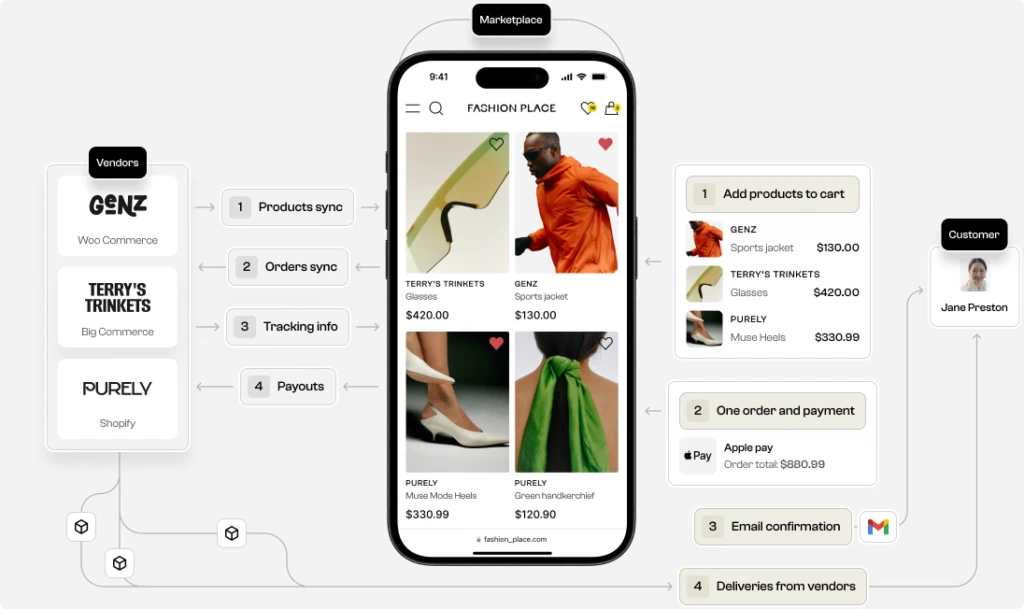
Spree Commerce Open Source: Simplifying Complex Multi-Vendor Marketplace Problems
If you’ve ever thought “we’ll just add a marketplace layer and off we go”, you might be in for a surprise. Marketplace projects carry a deceptively simple front-face (“many sellers, one storefront”) but behind the scenes they introduce a lattice of business, operational and technical complexity. A telling anecdote on Reddit captures this well; one commenter in the r/ecommerce forum warned:

Key Takeaways
Who it’s for: Founders, product leaders, and engineering managers who underestimated multi-vendor marketplace complexity, or are about to.
What it delivers: A diagnosis of why marketplace projects spiral (actors, payments, logistics, governance, UX, integrations) plus how Spree Commerce open source modules answer each.
Why it matters: Most stalled marketplaces stalled on operational complexity, not on the idea; picking a foundation built for marketplace patterns saves months of custom work.
Last verified: April 2026.
“I think the mistake we made was assuming a marketplace was just a store with more vendors. It’s really a _platform_ with multiple actors, workflows, payment splits, commissions, shipping models … and everything magnifies.”
That kind of thread is gold because it reminds us: scaling from a single-seller e-shop to a multi-vendor marketplace elevates nearly every dimension of the business.
In this post we’ll unpack why marketplace complexity escalates so quickly, and then show how the Spree Commerce open source multi-vendor marketplace module is built to tame it, from vendor onboarding to unified checkout to admin dashboards and beyond.
Why Marketplace Projects Are Inherently Complex
Here are the core drivers of complexity that often catch teams off-guard:
1. More actors, more roles
In a classic direct-to-consumer store you have: you (the merchant), and the customer. In a marketplace you add vendors (third-party sellers), potentially fulfilment partners, commissions, payouts, vendor onboarding workflows, vendor dashboards, and more. Each actor brings its own data flows, permissions, statuses, and expectations.
2. Payment, payouts & order splitting
Marketplace business means splitting orders between vendors, managing commissions (or margins), handling payouts, fees, KYC for vendors, refunds across multiple parties. The Reddit thread reflects how a small mis-assumption in this area can multiply downstream complexity.
3. Multi-vendor shipping & logistics
Different vendors may ship differently (own stock vs dropship vs third-party logistics), have different shipping methods, regions, return policies, holiday mode, etc. Coordinating a “single checkout” experience that behind the scenes handles multiple vendors pushes complexity up.
4. Unified customer experience
From the buyer’s perspective, you want them to feel like a single storefront, seamless discovery, unified cart, consistent look and feel, transparent shipping and returns, trust across all vendor transactions. But behind the scenes you have different vendors, different processes. Aligning them is non-trivial.
5. Platform governance, vendor management & scalability
As you onboard more vendors you need workflows: who approves them, what permissions they have, how you monitor vendor performance, how you enforce policies, how you handle vendor suspension or removal, how you scale as vendor count grows. The marketplace becomes a platform business, not just a store.
6. Complexity in discovery, catalog & UX
Multiple vendors means multiple catalogs, possibly overlapping SKUs, variant complexity, vendor-specific branding, curated collections across vendors. And if you handle multi-country, multi-currency, multi-language, that further adds to the complexity.
7. Technical integration & API complexity
Supporting a marketplace often demands integrations: vendor portals, third-party platforms (e.g., syncing with Shopify or WooCommerce), headless frontend, payment/settlement systems, analytics, etc. That means more moving parts, more orchestration.
In short: what looks like a single “more-sellers” flip ends up being a shift from “store” to “platform”, and many of the hidden complexities scale more than linearly.
Why Spree Commerce Is a Solid Foundation for Marketplace Projects
Now the good news: when you choose your foundation with marketplace complexity in mind, you give yourself a major head-start. That’s where Spree Commerce shines. Let’s walk through how Spree Commerce addresses many of the complexity levers above.
Marketplace Model
The Spree Commerce marketplace model documentation highlights exactly this shift, from regular e-commerce to “multi-vendor marketplace” as a first-class use-case. Your project becomes more about managing multiple vendors under one storefront, rather than “just another store”.
Marketplace Capabilities
Spree Commerce documents a wide range of marketplace-specific capabilities: vendor onboarding, vendor dashboards, multi-vendor checkout & order splitting, payouts, analytics, APIs, multi-currency/multi-language, mobile-first storefront, etc. That means you’re not designing all these from scratch, you’re working with a platform that anticipates many of the issues.
Admin Dashboard
The admin dashboard of a marketplace needs to handle what we called “platform governance”: vendor approval, permissions, commissions, vendor performance monitoring, catalog oversight, etc.
The Spree Commerce admin dashboard includes vendor invites/approval workflows, permission controls, commission management at global/vendor/product level. Meaning you get the governance tools you need out of the box (or at least as a clear place to build your extensions).
Vendor Dashboard
The vendor (seller) experience matters. Spree Commerce offers a marketplace vendor dashboard where sellers can manage products, orders, shipments, refunds, settings; supports manual or CSV import, or integrations with Shopify/WooCommerce for sync. When you give vendors a good UX, onboarding and ongoing operations scale more easily.
Customer UX
Marketplace UX for the buyer is a class of its own. Spree Commerce addresses this: unified shopping cart across vendors; transparent shipping per-vendor; consistent storefront; localization (language & currency); product discovery by brand/vendor; optimized mobile UX; express checkout options including Apple Pay, Google Pay, BNPL. This helps ensure the customer sees a coherent experience even though behind the scenes things are more complex.
Pulling It Together: How to Approach Your Marketplace Project
Here’s a suggested roadmap (and mindset) for scaling a marketplace, with Spree Commerce as your foundation:
- Design for the Platform, not just the Store. Start by mapping all actors (admin, vendors, customers, fulfilment/logistics, payments) and their workflows. Don’t assume a store-model will scale.
- Choose your foundational platform wisely. Ensure your platform supports multi-vendor onboarding, payouts/commissions, vendor dashboards, unified checkout, vendor-specific shipping/returns, multi-currency/language. Spree Commerce ticks many of these boxes out of the gate.
- Define vendor lifecycle early. How will you onboard vendors? Approval workflows? What permissions/roles? How will you monitor vendor performance, suspend vendors? What commission or fee model? The Spree Commerce admin dashboard helps with this.
- Design a unified buyer experience. Even though multiple vendors behind the scenes, the customer should have one seamless flow. Unified cart, consistent look/feel, transparent shipping/returns, trusted checkout. Spree Commerce customer UX capabilities address this.
- Build vendor operations and integrations. Vendors need efficient portals. CSV import, platform integrations (Shopify/WooCommerce), analytics. The smoother you make their operations, the more you’ll scale vendor count without bottlenecks.
- Plan payment & payout flows. Multi-vendor checkout means splitting orders, calculating commissions, managing vendor payouts, refunds, taxes. Spree Commerce supports multi-vendor order splitting and automated payouts (e.g., with Stripe Connect).
- Think scale: performance, catalog, discovery. As vendors and SKUs grow, your product catalog, search, discovery, storefront performance become critical. Also consider localization, multiple currencies/languages, mobile UX. Spree Commerce supports those features.
- Governance, metrics & vendor performance. Monitor vendor KPIs, track performance, enforce quality. The Spree Commerce admin dashboard gives you tools, but you’ll want custom dashboards, alerts, policies.
- Iterate & evolve. The marketplace space evolves: new vendors, new selling models (dropship, print-on-demand), new payment methods, global shipping, returns. With a flexible, API-first platform like Spree Commerce, you’ll be better positioned to adapt.
Why Many Marketplace Projects Fail or Stall
Despite all the above, many stall or fail, not because the idea is bad, but because the complexity is underestimated.
From the Reddit discussion and general marketplace experience:
- Teams assume they can treat the marketplace like a store and neglect vendor operational workflows.
- Checkout/payment/payout flows get hacked together and later become brittle when vendor count grows.
- Customer experience suffers because the multi-vendor nature isn’t hidden properly (confusing shipping, partial fulfilments, mixed vendor branding).
- Vendor onboarding and operations become a bottleneck, you can’t scale vendors because the portal is poor or manual.
- Governance and vendor performance slip, marketplace reputation suffers.
- The tech stack wasn’t built for multi-tenant/multi-vendor scale, leading to technical debt.
By choosing a platform like Spree Commerce that anticipates many of these issues, you mitigate risk, not eliminate it, but you reduce unknowns and accelerate time-to-value.
Final Thoughts
If you’re going into a marketplace project (or thinking about it), treat it as building a marketplace platform, not just “another store.” Recognize upfront the added layers of vendor management, payments/payouts, logistics, unified UX, and governance.
With Spree Commerce as your foundation, you get a platform designed for that purpose. You gain vendor dashboards, admin workflows, multi-vendor checkout, unified customer experience, and API-first flexibility, all the pieces that help you focus on your business model, vendor ecosystem, and growth rather than reinventing each layer.
Frequently Asked Questions
What makes a multi-vendor marketplace project more complex than a regular online store?
Spree Commerce models a marketplace as a platform with three first-class actors (admin, vendor, customer), each with their own workflows, permissions, and data, instead of a single-seller store with bolted-on multi-vendor logic. The architectural difference is what generates the complexity teams underestimate: actor permissions, multi-party payments, per-vendor shipping, governance, and unified UX all scale faster than a single-store platform expects.
How does Spree Commerce simplify multi-vendor checkout and order splitting?
Spree Commerce supports unified multi-vendor checkout that merges products from multiple sellers into one cart, splits the order automatically by vendor at submission, applies per-vendor shipping logic, and routes a single customer payment to the correct vendor accounts on the backend. Customers pay once; vendors see only the lines they fulfill; operators see one unified order record.
What does the Spree Commerce admin dashboard handle for marketplace governance?
Spree Commerce includes a marketplace admin dashboard with vendor invite and approval workflows, role-based permission controls, commission management at the global, vendor, or product level, vendor performance KPIs, catalog oversight, and central reporting. Operators get the governance tools needed to onboard, monitor, and suspend vendors out of the box, plus a foundation to build custom workflows on.
How do vendors operate independently on a Spree Commerce marketplace?
Spree Commerce gives each vendor a self-service marketplace vendor dashboard for product management with manual or CSV import, order fulfillment scoped to the vendor’s own orders, refund processing, and integrations with Shopify or WooCommerce for catalog sync. The less an operator has to touch per vendor, the more vendors the platform supports without adding operations headcount.
Can a Spree Commerce marketplace localize for multiple currencies and languages?
Spree Commerce supports multi-currency and multi-language localization, region-specific tax and shipping rules, currency conversion, localized catalogs, and integration with tax providers like Avalara or TaxJar. The same marketplace can serve buyers across countries with the right tax, currency, and language for each region without forking the storefront.
How does Spree Commerce keep the multi-vendor customer experience unified?
Spree Commerce provides a unified shopping cart across vendors, transparent per-vendor shipping in checkout, a consistent storefront look and feel, product discovery by brand or vendor, mobile-first templates, and express-checkout support including Apple Pay, Google Pay, and Buy Now Pay Later. Customers experience the marketplace as one cohesive store while the platform routes the complexity behind the scenes.
Why do marketplace projects stall, and how does Spree Commerce reduce the risk?
Spree Commerce provides multi-vendor architecture, vendor onboarding workflows, payment splitting and payouts, unified customer UX, and governance tools as native modules in the open-source platform. Marketplaces stall when teams treat them as “stores with more sellers” and hack together checkout, payouts, and onboarding; starting on a platform that anticipates those problems removes a class of unknowns and shortens time-to-value. Ready to simplify your marketplace project? Explore the Spree Commerce marketplace platform or dive into the marketplace capabilities reference to map your roadmap.