


The Ultimate Guide to Multi-vendor Marketplace eCommerce
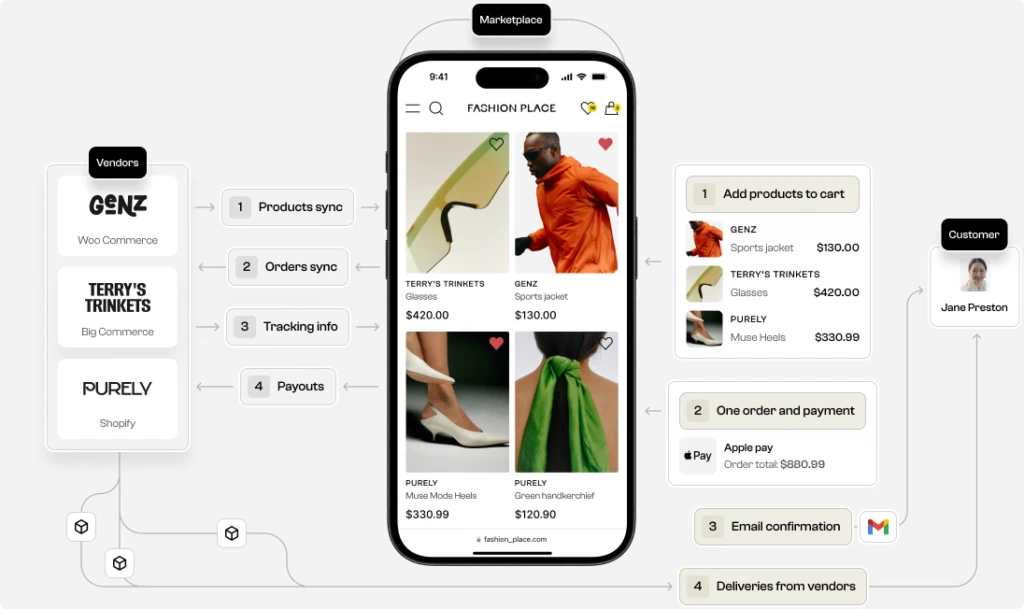
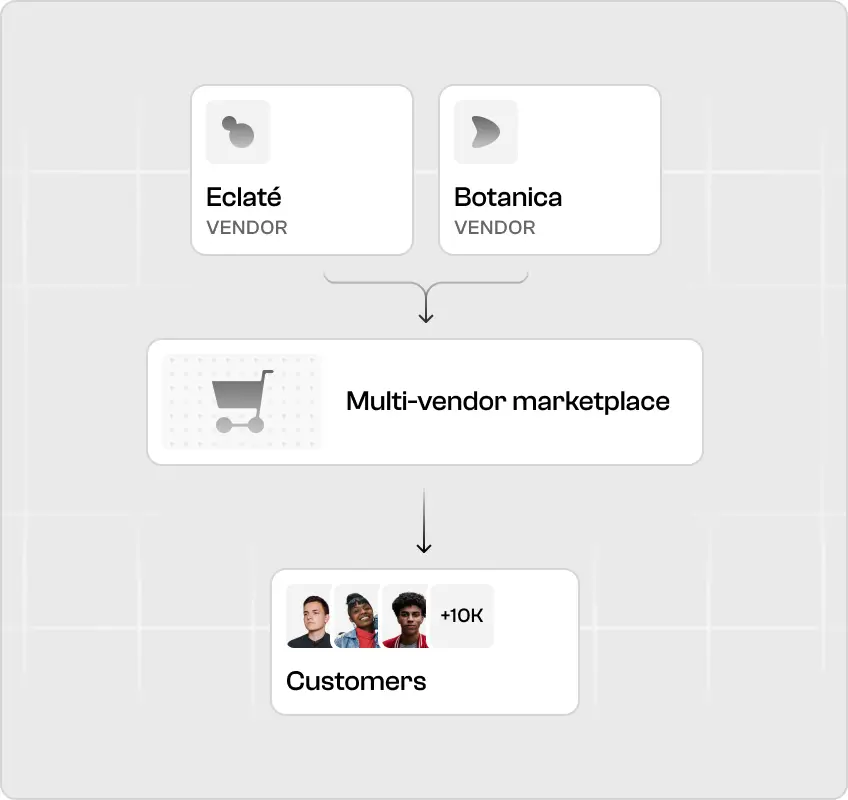
A multi-vendor marketplace is an eCommerce platform where multiple independent sellers offer their products through a single storefront, while customers experience one unified shopping journey. Like Amazon: one customer order, multiple products from many vendors.
The platform owner manages the vendor onboarding, marketplace merchandising, customer experience, payment splitting and vendor payouts, and vendor performance, while vendors focus on listing products and fulfilling orders. This model is used to build general marketplaces similar to Amazon, Etsy, or industry-specific B2B and B2C platforms.
Spree Commerce enables this model by providing a open-source multi-vendor marketplace platform that supports vendor onboarding, product ownership, order splitting, commissions, payouts, and role-based dashboards.
Marketplace operators can retain full control over branding, customer experience, and data, while vendors operate independently within defined boundaries. The result is a scalable marketplace platform that can grow from a handful of vendors to thousands without changing core architecture.
Marketplace Model: Key Questions
How does a multi-vendor marketplace work in Spree Commerce?
Spree Commerce implements a multi-vendor marketplace model where vendors own their own products, inventory, and fulfillment processes, while the marketplace owner controls the storefront and checkout.
In this model:
- Customers browse a single storefront and place one combined order
- The platform automatically splits the order by vendor
- Each vendor fulfills their portion of the order independently
- The marketplace handles payments and applies commissions
This approach keeps the customer experience simple while allowing vendors to operate independently behind the scenes.
Who owns customers, orders, and payments in a Spree marketplace?
In Spree, the marketplace owner owns the customer relationship, while vendors own their products and fulfillment responsibilities. Payments flow through the platform first, enabling the marketplace to enforce rules and monetize transactions.
Ownership is clearly defined:
- Customers belong to the marketplace, not individual vendors
- Orders are created once at checkout and then split internally per vendor
- Payments are processed by the platform, allowing commission deduction
- Vendor payouts happen after order completion or fulfillment milestones
This structure gives marketplace operators full visibility into performance, customer behavior, and revenue while still empowering vendors.
Can a marketplace support both physical and digital products?
Yes. Spree supports marketplaces that sell:
- Physical goods requiring shipping and tracking
- Digital products with instant delivery
- Services, bookings, or subscriptions (with customization)
Each vendor can define fulfillment logic appropriate to their product type, while the platform maintains a consistent checkout and order lifecycle.
Marketplace Capabilities: What the Platform Supports
Spree Commerce Enterprise Edition provides a full set of out-of-the-box multi-vendor marketplace features, while remaining flexible enough to support advanced customization.
How are vendors onboarded and managed?
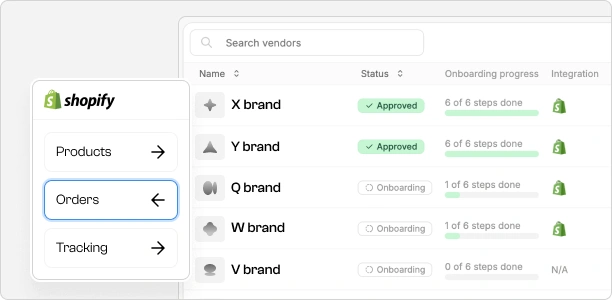
Spree allows marketplace owners to control how vendors join the platform, whether through manual approval, invitation-only onboarding, or application-based workflows.
Vendor management capabilities include:
- Creating and approving vendor accounts
- Assigning vendor roles and permissions
- Enabling or restricting access to specific features
- Suspending or deactivating vendors when needed
This ensures quality control and protects the integrity of the marketplace.
How does product ownership work in a multi-vendor setup?
Each product in a Spree marketplace is explicitly linked to a vendor. This ensures that:
- Vendors manage only their own products
- Inventory is tracked per vendor
- Pricing and availability are vendor-specific
The marketplace owner can still enforce global rules, such as required attributes, category structures, or prohibited product types.
How does order splitting work behind the scenes?
When a customer places an order containing items from multiple vendors, Spree automatically:
- Creates a single checkout and payment
- Splits the order internally into vendor-specific sub-orders
- Assigns each sub-order to the relevant vendor dashboard
- Tracks fulfillment, shipping, and returns per vendor
This ensures vendors see only the orders they are responsible for, while customers experience one seamless purchase.
Can the marketplace charge commissions or fees?
Yes. Spree supports flexible marketplace monetization models, including:
- Percentage-based commissions per order
- Fixed fees per transaction
- Vendor subscription plans
- Hybrid models combining subscriptions and commissions
Commission rules can be applied globally or customized per vendor, giving marketplace operators full control over revenue strategy.
Marketplace Admin Capabilities: Platform Owner Controls
What does the marketplace admin dashboard allow me to manage?
The marketplace admin dashboard is the central control center for the entire platform. From here, operators manage vendors, products, orders, payments, and overall performance.
Admin capabilities include:
- Vendor approval, suspension, and role management
- Global catalog rules and category structures
- Commission configuration and revenue tracking
- Order oversight across all vendors
- Customer support and dispute handling
This centralized view ensures consistency, compliance, and scalability.
How does the marketplace control payouts to vendors?
Spree allows marketplace owners to control when and how vendors get paid, enabling safeguards against fraud and disputes.
Payout workflows can include:
- Holding funds until orders are shipped or completed
- Delaying payouts for return windows
- Manual or automated payout approval
- Integration with payment processors for vendor disbursements
This protects both the platform and customers while ensuring vendors are paid fairly.
Can the marketplace enforce branding and UX consistency?
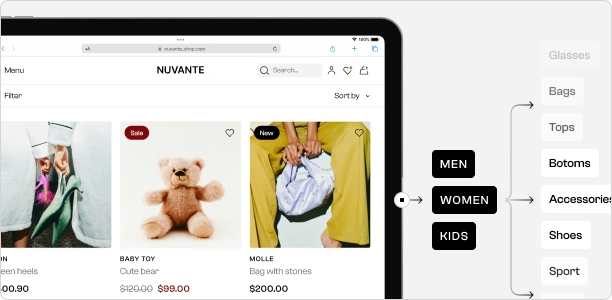
Yes. The marketplace owner controls the storefront, checkout flow, and overall brand experience. Vendors do not create their own storefronts—instead, they sell within the platform’s design system.
This ensures:
- A consistent customer experience
- Unified navigation and checkout
- Centralized SEO strategy
- Strong marketplace brand identity
Vendor Capabilities: What Sellers Can Do

What does the vendor dashboard provide?
Each vendor receives a dedicated marketplace vendor dashboard where they manage their business independently, without access to competitor data.
Vendor dashboards support:
- Product creation and management
- Inventory and pricing updates
- Order fulfillment and shipping status
- Refund and return handling (within platform rules)
- Sales and performance reporting
This separation ensures vendor autonomy while maintaining platform governance.
How do vendors manage products and inventory?
Vendors can:
- Create and edit their own product listings
- Upload images, descriptions, and variants
- Manage stock levels per SKU
- Temporarily disable products or mark them out of stock
The platform can enforce required attributes or category placement to maintain quality standards.
Can vendors control shipping and fulfillment?
Yes. Vendors manage fulfillment for their own orders, including:
- Shipping methods and carriers
- Tracking numbers and shipment updates
- Fulfillment statuses
Customers receive unified notifications even when multiple vendors are involved.
What analytics do vendors have access to?
Vendors can view vendor-specific analytics, such as:
- Sales volume and revenue
- Order counts and fulfillment rates
- Best-selling products
- Time-based performance trends
They do not see data from other vendors or platform-level financials.
Customer Experience: Buying from Multiple Vendors
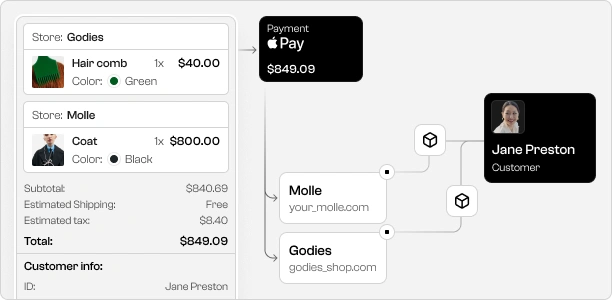
What does the customer see during checkout?
Customers interact with one storefront, one cart, and one checkout, regardless of how many vendors are involved.
From the marketplace customer’s perspective:
- Products from multiple vendors can be added to a single cart
- Checkout happens once with one payment
- Confirmation emails summarize all items
- Orders may ship separately but remain linked
This removes friction and increases conversion rates.
How are shipping and delivery handled for customers?
Spree clearly communicates shipping expectations by vendor, while keeping the checkout experience simple.
Customers can:
- See shipping costs per vendor if applicable
- Receive separate tracking numbers
- Track each shipment independently
Despite multiple shipments, the experience feels cohesive.
How are returns and refunds managed?
Returns and refunds follow platform-defined rules but are executed at the vendor level.
This allows:
- Vendors to approve or reject returns for their products
- The marketplace to oversee disputes
- Customers to initiate returns from a single account area
The platform ensures consistent policies while allowing vendor flexibility.
Marketplace Use Cases
How does Spree support B2C marketplaces like Etsy or Amazon-style platforms?
Spree supports consumer marketplaces by enabling:
- Large vendor catalogs
- High-volume order processing
- Commission-based monetization
- Strong SEO and unified branding
This model works well for handmade goods, fashion, electronics, and niche verticals.
How does Spree support B2B marketplaces?
For B2B marketplaces, Spree can be extended to support:
- Vendor-specific pricing
- Customer approval workflows
- Bulk ordering and negotiated pricing
- Account-based purchasing
This makes it suitable for wholesale platforms and industrial marketplaces.
Can Spree support hybrid marketplace models?
Yes. Spree supports hybrid platforms where:
- The marketplace sells its own products
- Third-party vendors sell alongside the platform
- Different commission or pricing rules apply
This allows gradual marketplace expansion without restructuring the platform.
Enterprise Edition Overview and Closing Thoughts
Multi-vendor marketplace capabilities, including streamlined vendor onboarding and operational automation as well as automated payment splitting and vendor payouts, are part of the Enterprise Edition, which includes a fully fledged marketplace solution, dedicated support, and performance optimizations designed for complex platforms. Marketplace operators benefit from full source access, deployment flexibility, and ownership of their platform and data—without SaaS limitations.
There is also an open-source multi-vendor marketplace module included with the Community Edition which comes without vendor and payment automations but otherwise is a fully featured marketplace solution. Should you like to integrate your own payment provider and onboard vendors in the most convenient way, this open-source marketplace software could be a good fit.
Spree Commerce provides the foundation to build scalable, secure, and fully customizable multi-vendor marketplaces. By combining vendor autonomy with centralized control, Spree enables marketplace operators to grow supply, attract customers, and evolve their business model over time—whether launching a niche marketplace or scaling a global platform.
Frequently Asked Questions
What is a multi-vendor marketplace platform?
A multi-vendor marketplace platform lets multiple independent sellers list and sell products through a single online storefront. The platform operator manages the catalog, checkout, and payment splitting while vendors handle their own inventory and fulfillment. Examples range from Amazon and Etsy to specialized B2B procurement marketplaces serving specific industries.
How do payment flows work in a multi-vendor marketplace?
The marketplace collects payment from the buyer, deducts a commission (typically 10-30% in B2B marketplaces), and distributes the remainder to each vendor. This requires payment orchestration that handles split payments, escrow, and automated payouts. Stripe Connect and Adyen for Platforms are commonly used, and both integrate with Spree Commerce.
What is a B2B marketplace?
A B2B marketplace connects business buyers with multiple wholesale suppliers on one platform, enabling bulk ordering, negotiated pricing, and approval workflows. Unlike consumer marketplaces, B2B platforms handle purchase orders, net payment terms, and buyer organizations with multiple users. Spree Commerce supports both B2B and B2C marketplace models natively.
Can I build a multi-vendor marketplace like Amazon?
Yes, but you need a platform designed for marketplace operations from the start. Key requirements include vendor onboarding, per-seller product management, commission calculation, and split payment processing. Building from scratch typically costs $100K-$500K and takes 6-12 months. Using a marketplace-ready platform like Spree cuts both timeline and budget significantly.
What are examples of successful multi-vendor marketplaces?
Well-known multi-vendor marketplaces include Amazon, Etsy, and Alibaba in the consumer space, and Thomasnet and Faire in B2B. Enterprise operators also build private procurement marketplaces for internal supplier management. Each model requires different platform capabilities: consumer marketplaces prioritize discovery, while B2B marketplaces need approval workflows and volume pricing.
Can a marketplace platform handle both B2B and B2C selling?
Yes, though most platforms force you to choose one model. Spree Commerce supports B2B and B2C marketplace operations from a single codebase, with role-based pricing, buyer organizations, and consumer checkout running side by side. This matters for operators serving both wholesale distributors and end consumers through one catalog.
How much does it cost to build a multi-vendor marketplace?
Custom marketplace builds typically range from $100K to $500K depending on vendor count, payment complexity, and integration requirements. Starting with an open-source marketplace framework like Spree reduces initial development costs because core commerce, vendor management, payment splitting, and API layers come pre-built rather than coded from scratch.