


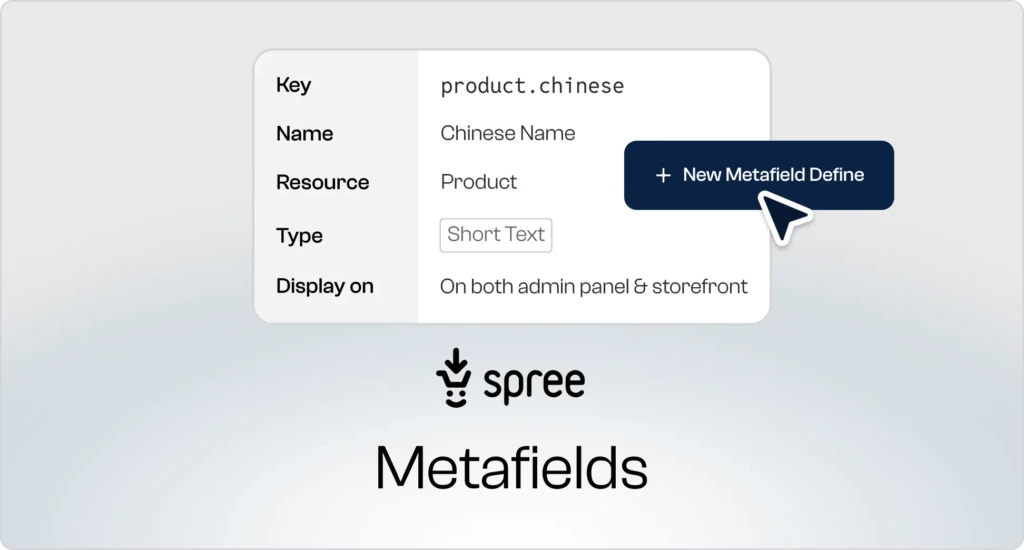
Metafields — Any Custom Attributes For eCommerce
With Spree 5.2, metafields introduce one of the most powerful enhancements the platform has seen in years. Metafields allow merchants, product teams, and developers to extend any Spree model (eg. Products, Variants, Categories, Customers, Orders, Stores, Vendors) with custom attributes — without touching the database, writing migrations, or modifying core code.
This is a major leap toward faster go-to-market times, richer storefront experiences, and dramatically more flexible use-case support.
In this deep dive, we’ll explore:
- What metafields are
- How they work across Admin and API
- Practical examples for B2C, B2B & marketplaces
- The business value metafields unlock for real stores
What Are Metafields?
Metafields are custom attributes attached to any Spree model, such as:
- Products
- Variants
- Categories
- Customers
- Orders
- Stores
- Vendors
Instead of editing your database schema or asking developers for help, admins can define fields like:
- Text
- Rich text
- Numbers
- Boolean values
- JSON
- Lists
- (Coming in 5.3) Relations to other models
Each metafield:
- Is fully manageable from Admin
- Is accessible via API for headless storefronts
- Can power storefront UI elements, filters, recommendations, or integrations
Why Metafields Matter — The Business Value
1. Faster go-to-market time
No more waiting for developers to add attributes like “material,” “region,” “brand story,” “care instructions,” “HS code,” etc.
Business teams can test, adjust, and publish new content instantly.
2. Perfect for merchandising and product storytelling
Modern commerce requires rich content — detailed attributes, technical specs, visuals, comparison charts, sustainability data.
Spree metafields make all of this easy.
3. Lower development costs
No migrations =
- No engineering cycles
- No deployment pipeline
- No risk of breaking database structures
Teams can focus on impactful features instead of schema updates.
Examples by Industry
? Furniture & Home Decor
A furniture retailer could use metafields to define:
- Wood type: walnut, oak, ash
- Fabric texture: velvet, linen, boucle
- Polish/finish: matte oil, gloss varnish
- Care instructions: downloadable PDFs or rich text
- Materials photos: fabric swatches, zoomable grain textures
These attributes can then drive:
- Filter menus (e.g., “Show oak tables only”)
- PDP detail sections
- Product comparison tools
- AI-driven recommendations (“Similar styles in walnut”)
? Fashion & Apparel
Metafields can define:
- Fit notes
- Model measurements
- Wash instructions
- Size guides per product
- Sustainability notes (e.g., organic cotton certification)
- “Complete the look” curated outfits
? B2B Industrial, Electronics, Supplies
Typical attributes include:
- Technical specifications
- Compliance certificates
- Parametric values (voltage, density, torque, etc.)
- Product documentation links
- MSDS sheets
Perfect for B2B procurement platforms where buyers expect structured, searchable specs.
? Marketplaces
Vendors can be given metafields such as:
- Brand story
- Shipping lead time
- Warranty policies
- Return restrictions
- Regulatory region tags
This improves:
- Vendor onboarding
- Data consistency
- Customer trust
How to Use Metafields in Practice
From Admin
Admins can define metafields by selecting:
- Model
- Namespace
- Key
- Value type
- Default value (optional)
Once created, metafield inputs automatically appear in the Admin UI for relevant models.
In API / storefront
Headless storefronts can pull metafield data to dynamically generate:
- PDP layouts
- Technical spec tables
- Custom blocks
- Personalization widgets
Why This Changes Everything
Spree 5.2 metafields remove one of the last major blockers to rapid customization.
Merchants, category managers, and growth teams can now:
- Rapidly experiment
- Expand product content
- Create conversion-optimized PDPs
- Build advanced filters
- Support new channels faster
Meanwhile, developers get:
- A clean, maintainable core
- Fewer schema changes
- Fully typed structured data
- Upgrade-safe extensions
It’s a win for everyone.
? Why Spree 5.2
Metafields are one of the defining features of Spree 5.2, a release focused on improving developer experience, customization capabilities, and enterprise workflows. Alongside updates to the Installer, Admin SDK, Page Builder, CSV importer, and more, metafields represent Spree’s continued commitment to delivering a platform that allows businesses to build exactly what they need — faster and with fewer constraints.
Spree 5.2 is a major step forward in empowering:
- Merchant teams to control more of the storefront
- Developers to work faster and more efficiently
- Large-scale platforms to customize and differentiate
Metafields exemplify this vision — enabling powerful, flexible data modeling without compromising performance or maintainability.
? Spree Enterprise Edition — Support, Scale & Security
For teams with more complex requirements — including multi-vendor marketplaces, B2B organizations, multi-tenant SaaS platforms, or regulated environments — Spree Commerce Enterprise Edition extends metafields and the broader Spree 5.2 ecosystem with:
Enterprise-Grade Modules
- Multi-Vendor Marketplace
- B2B eCommerce
- Multi-Tenant eCommerce
(Each delivered as a private gem)
Support & Upgrade Path
- Access to ongoing enhancements
- Priority security updates
- Slack & email support
- Premium Support for consulting, integrations, and maintenance
Security & Compliance Features
- Hardened authentication & authorization
- Regular framework upgrades
- Infrastructure guidance
- Optional managed hosting with SLAs
Enterprise Edition is for businesses that need:
- Guaranteed stability
- High scalability
- Operational continuity
- Engineering support
- Predictable upgrade paths
It gives organizations the confidence and tooling needed to operate Spree at global scale with strong guarantees.
Conclusion
Metafields are not just a new feature — they’re the foundation for a more flexible, customizable Spree ecosystem. Whether you’re building a B2C storefront with rich product storytelling, a B2B platform with technical specifications, or a marketplace with vendor-specific attributes, metafields give you the tools to adapt Spree to any use case.