

Reviewing Seller Transfers
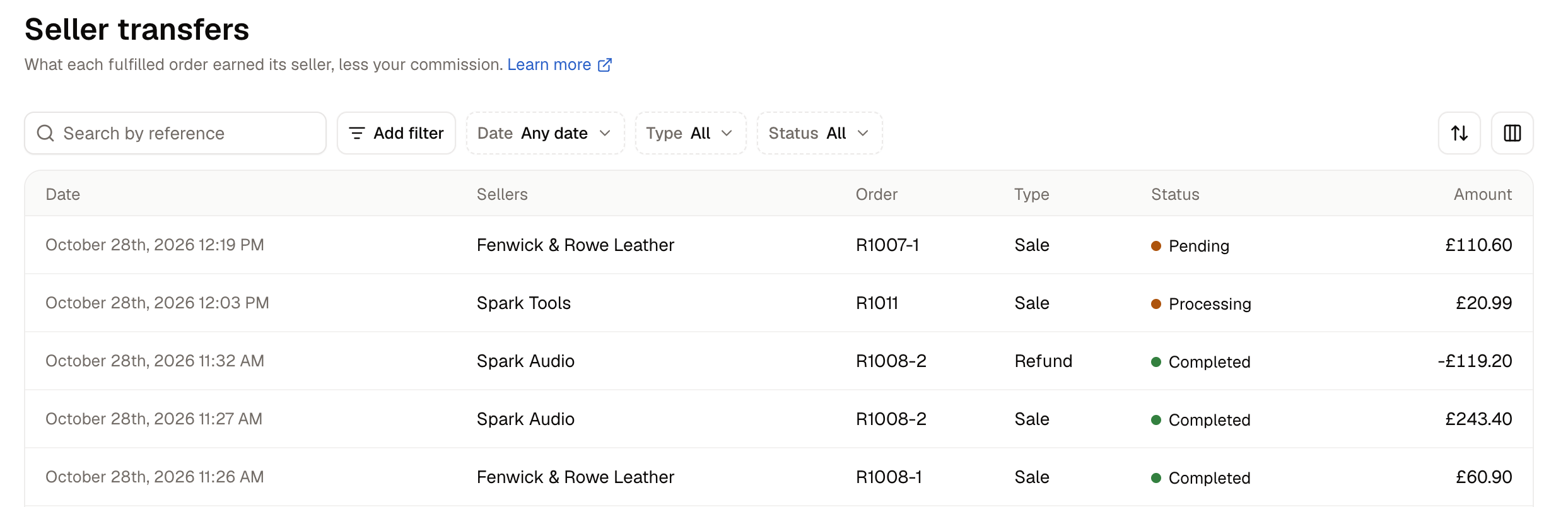
Filters narrow the list by date, seller, type and status, which is how a single seller’s history over a period is read.
Transfer Statuses
What a status means depends on how your marketplace pays its sellers, which is set under Marketplace Settings. Where no payment provider is connected, Spree records what each seller is owed and you send the money yourself by bank transfer. Nothing is being attempted on your behalf, so every transfer is marked Completed the moment it is created and no other status appears on the list. Where a provider such as Stripe Connect is connected, the provider moves the money and reports back, and a transfer passes through the following:A transfer records what a seller is owed rather than money moving. Even with a provider connected, a transfer is one half of the ledger: the money reaches the seller through a payout, which is a separate record. See Payouts.
When a Transfer Is Created
A transfer is created when a seller order is fully fulfilled, not when it is placed or paid. Every item has to have gone out, so an order with one parcel still outstanding earns nothing yet, and an order sitting unfulfilled shows a commission on its own page while having earned the seller nothing. How the customer paid makes no difference. An order settled with store credit or a gift card produces the same transfer a card payment would, because how the sale was funded is a matter for your marketplace rather than for the seller. An order sold by your own team rather than by a seller has no seller against it, so no transfer is created for it.Where a payment provider is connected, a seller whose account with that provider is not ready yet is still credited. The transfer is recorded and held at Pending until their account can receive the money, and is sent once it can.
What a Seller Earns
A transfer is the order total, less the consumer tax where your marketplace remits it, less the commission charged on the order including the tax on that commission. It can never be less than zero. Taking an order of $120.00 on a marketplace charging 10%, where the seller remits their own tax:
Where the seller’s Tax remitted by is set to the marketplace rather than to the seller, the consumer tax on the order comes off as well, because the marketplace files it and the seller never holds it. That setting is on the seller’s own page under Sellers.
The commission subtracted is the exact amount recorded against the order at the moment it was placed. Spree does not look up the commission rate again and recalculate the fee when the transfer is created.
This matters because the recorded fee and the current rate can disagree. The rate may have been edited since the order was placed, the fee may have been limited by a floor or a cap, or a flat fee may have been charged per unit rather than as a share of the total. In each of those cases, applying today’s rate to the order total would produce a different number from the one the seller was actually charged. See Commission Rates.
Refunds
Refunding a seller order writes a second transfer against the same order, as a negative figure, rather than editing the first one. The amount taken back is the seller’s share of what was refunded, not the whole of it. A refund is the customer’s gross figure and carries both the consumer tax and your commission, while the seller only ever received their net cut, so clawing back the gross would charge them commission on goods that came back. On the $120.00 order above, refunding the customer in full takes $108.00 back from the seller. How that share is worked out depends on what the refund can say about itself:- A return or a claim names the lines it paid for, so the share is what those lines actually earned, scaled to the amount refunded. A restocking fee or a goodwill payment on top is absorbed by that scaling.
- A manual refund or a cancellation is only an amount against an order, so the order’s own ratio of earnings to total is used instead.
Refunding an order before it is fulfilled reverses nothing, because the seller has not been credited for it yet. Where such an order is fulfilled afterwards, the seller is credited the full earning and the earlier refund is not taken off it.
How a Seller’s Balance Is Built
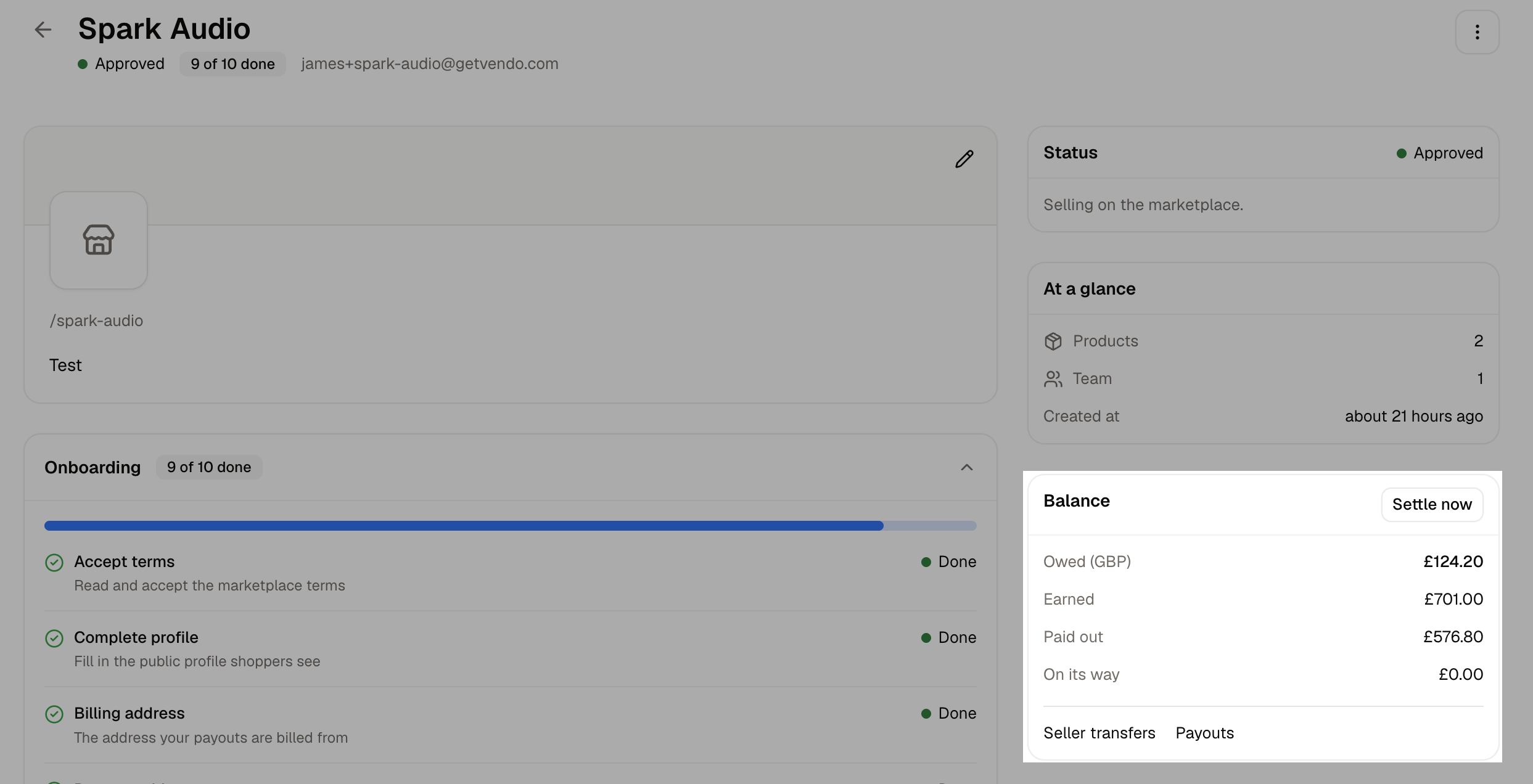
On its way counts transfers rather than payouts, so a seller whose balance has been swept into a payout that has not been marked paid reads zero here, with the amount showing under Owed until the payout is marked paid.
Nothing is converted between currencies. A seller trading in two currencies holds two positions on the card rather than one total, and where their account settles in a currency other than the one they sold in, the card shows both what the sales were worth and what the account received.
Further Reading
- Payouts - Settling these earnings and recording them as paid
- Commission Rates - What is deducted before a transfer is created
- Marketplace Orders - The orders these transfers come from
- Sellers - The seller pages carrying the balance card